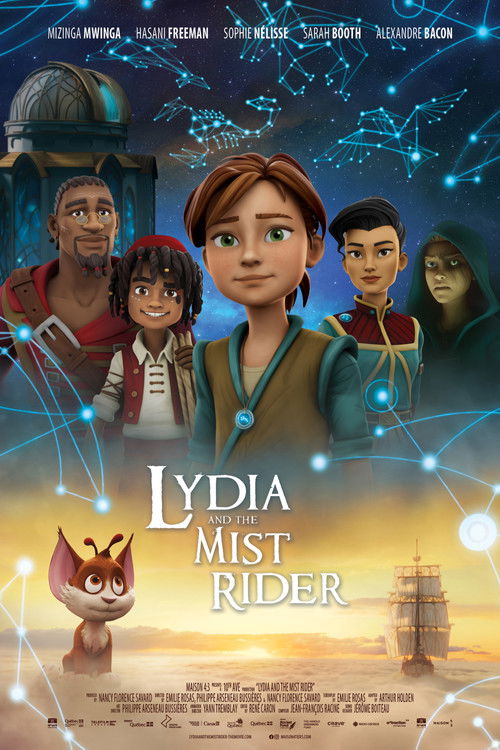
Lydia and the Mist Rider (2026)
Directed by Nancy Florence Savard
Partly · Woke-Adjacent
How we score movies →Consciousness Markers
Strong female protagonist with diverse voice cast including actors of color in substantive roles. The casting appears intentionally inclusive without relying on stereotypical character types.
Female protagonist takes active agency in the narrative, but the story is not explicitly about gender dynamics or feminist themes. Lydia's heroism is presented as individual capability rather than commentary on gender.
Diverse casting suggests racial consciousness in production, but no evidence of the narrative addressing racial themes or systemic racial issues within the story itself.
The film appears to prioritize plot and adventure over preachy messaging. Any thematic content is woven into narrative rather than delivered through explicit lectures or heavy-handed exposition.
No identifiable LGBTQ+ themes, characters, or representation in the available plot information or marketing materials.
No apparent climate-related themes, environmental messaging, or ecological consciousness in the film's fantasy adventure plot.
No evidence of anti-capitalist messaging, critique of wealth inequality, or commentary on economic systems in the available plot synopsis.
As an animated children's film, body positivity themes are not evident in the plot or thematic materials available.
No identifiable representation of neurodivergent characters or themes related to neurodiversity in the film.
A fantasy adventure with an original setting does not engage in historical revisionism as the narrative exists in a fictional magical world.
Synopsis
When her older brother Thaddeus is mysteriously kidnapped by the Spellbinder, 11-year-old Lydia sets off to find him in the Misty Sea. Picked up by the crew of a flying ship, the Dolphin, Lydia becomes the apprentice of Ambrosia, a Stargazer. Ambrosia is trying to find other children who have disappeared, including her own son. Determined to solve the mystery, Lydia must learn stargazing magic and ready herself to confront the Spellbinder.
Why it received this score
Lydia and the Mist Rider presents itself as a children's fantasy adventure with certain superficial markers of contemporary progressive sensibilities, though the execution remains largely traditional. The film centers on an 11-year-old female protagonist who takes active agency in her brother's rescue, supported by a diverse ensemble cast that includes actors of color in substantive roles. The direction by Nancy Florence Savard adds a layer of female creative leadership to what might otherwise be a straightforward quest narrative. These elements contribute measurably to the film's cultural positioning, yet they operate more as contextual facts than thematic imperatives.
The narrative itself resists the kind of self-conscious messaging that would push the film into higher registers of contemporary cultural consciousness. This is a story about magic and mystery rather than social awareness. The kidnapped children subplot could have become a vehicle for commentary on systemic injustice or institutional failure, but instead it functions as plot mechanics in a fairly conventional adventure framework. There is no emphasis on how systems enable the Spellbinder's crimes, no examination of power structures, and no interrogation of rescue narratives themselves. The film simply presents a young person solving a problem through determination and magical training.
What results is a competent family entertainment that reflects demographic realities and basic contemporary casting practices without being driven by any particular ideological commitment. The diverse voice cast feels organic to the production rather than performative, which paradoxically lowers the cultural consciousness quotient since genuine representation without explicit acknowledgment scores differently than representation deployed as cultural messaging. This is a film that happens to star women and people of color, rather than a film about the significance of women and people of color.
Analysis generated by our Consciousness Algorithm
Critic Reviews
“With Lydia and the Mist Rider, Philippe Arseneau Bussieres, Emilie Rosas and Nancy Florence Savard offer an adventure for the whole family on a ship that travels through the clouds in search of missing children.”