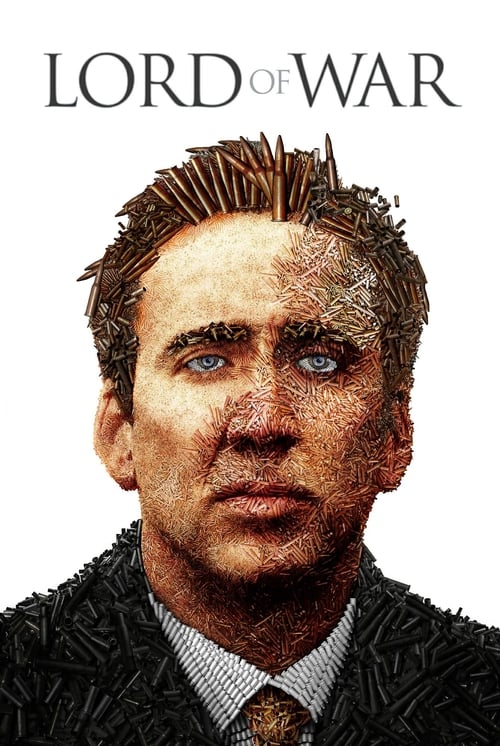
Lord of War (2005)
Directed by Andrew Niccol
No · Based
How we score movies →Consciousness Markers
Explicitly critiques arms trade as capitalist enterprise enabled by state complicity and shows how weapons manufacturers profit from human suffering through institutional corruption.
Film employs direct address and voice-over narration with occasional preachy elements, though Niccol trusts the audience to recognize satire without heavy-handed moralizing.
Depicts conflicts in African nations and African warlords as geopolitical commentary, but does not examine systemic racism or center Black experiences and perspectives.
Cast includes several actors of color but representation is not a thematic concern. Casting reflects narrative needs rather than deliberate diversity efforts.
Fundamentally masculine narrative with female characters existing peripherally. Bridget Moynahan's character lacks agency or independent development.
No LGBTQ+ themes, representation, or subtext present in the film.
Climate change and environmental concerns are entirely absent from the film.
Body image and physical appearance are not thematic concerns in the film.
No representation of neurodivergent characters or engagement with neurodivergence as a theme.
While referencing real geopolitical events, the film does not attempt to rewrite or reinterpret history.


Synopsis
Yuri Orlov is a globetrotting arms dealer and, through some of the deadliest war zones, he struggles to stay one step ahead of a relentless Interpol agent, his business rivals and even some of his customers who include many of the world's most notorious dictators. Finally, he must also face his own conscience.
Why it received this score
Lord of War presents itself as a cynical anatomy of international arms dealing, a system so thoroughly corrupted by profit motive that morality becomes quaint window dressing. Andrew Niccol's film follows Yuri Orlov through the mechanics of weapons trafficking with the detached precision of a documentary, complete with voice-over narration that occasionally breaks the fourth wall to ensure we understand the satire. Nicolas Cage delivers a performance of calculated charm, playing a man for whom conscience is a luxury item he cannot quite afford to abandon entirely.
The film's primary cultural achievement lies in its unflinching portrayal of capitalism as a self-perpetuating system that rewards those willing to exploit human suffering. The narrative demonstrates how arms dealers profit precisely because governments require plausible deniability, how the industry corrupts institutions from the ground up, and how even law enforcement becomes complicit in the machinery. Yet this critique remains fundamentally observational rather than transformative, offering condemnation without suggesting alternatives or systemic reform.
What prevents this film from scoring higher on contemporary cultural markers is its essential conservatism of form. It is a morally serious film about serious corruption, but it engages with these themes through the vocabulary of 1970s political cinema rather than contemporary progressive sensibilities. The cast is male-dominated, female characters exist peripherally, and while the film depicts conflicts in Africa and warlords from various nations, it does not center racial consciousness or examine systemic racism. The film's cynicism, while sometimes mistaken for radicalism, ultimately offers the viewer the comfort of knowing that the system is broken without requiring any personal reckoning or commitment to change. We leave the theater feeling appropriately disgusted at the arms trade, secure in the knowledge that we are not Yuri Orlov, which may be precisely the comfortable distance the film allows.
Analysis generated by our Consciousness Algorithm
Critic Reviews
“A bleak comedy, funny in a "Catch-22" sort of way, and at the same time an angry outcry against the gun traffic.”
“The film's tone is set by a bravura opening sequence that follows a single bullet from a factory conveyer belt to its resting place in a child's skull, and by Cage's flawlessly sardonic voice-over.”
“The result is a dead pile of information in search of a movie.”