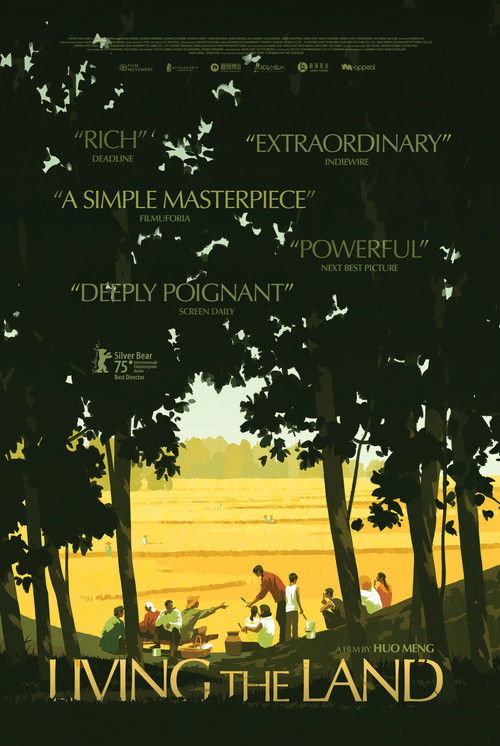
Living the Land (2025)
Directed by Huo Meng
No · Ultra Based
How we score movies →Consciousness Markers
The film observes, with quiet melancholy, how economic modernization pulls parents away from their children and erodes centuries of village life. The critique is implicit, elegiac, and entirely pre-ideological.
The film features an entirely Chinese cast in a story set in rural China. This is simply authentic casting, not the calculated demographic calculus of modern representation discourse.
No LGBTQ+ themes, characters, or subtext are present. The film is concerned with wheat fields and absent parents.
The story centers on a young male protagonist navigating traditional patriarchal village structures without any apparent interest in dismantling them.
There is no racial consciousness framework at work here. The film exists entirely within a single cultural context and makes no comparative racial arguments.
The film is attentive to the natural landscape of rural Henan, but agricultural life is depicted as backdrop and heritage, not as an environmental sermon.
No evidence of body positivity themes or commentary of any kind.
No neurodivergence themes or characters are identifiable in any available material about the film.
The film depicts early 1990s rural China in an observational mode. It is not rewriting history but recording a memory of it.
Critics consistently describe the film as patient, quiet, and documentary-like. Nobody is being lectured. The wheat fields simply quiver.
Synopsis
With both parents working far away, ten-year-old Chuang is being raised by extended family in his home village, where thousands of years of rural tradition collide with the socio-economic changes of China in the early 1990s.
Why it received this score
Huo Meng's Silver Bear-winning portrait of a ten-year-old boy adrift in a Henan village in 1991 is, by the metrics we are professionally obligated to apply here, a nearly complete void. There is no gender manifesto. There is no intersectional coalition. There is no character who turns to another character and explains systemic oppression. There is instead a child, some frost, some wheat, and the low hum of a civilization in the process of forgetting itself. We have reviewed films that scored lower, but we are struggling to remember when.
The film's sole concession to anything resembling a contemporary social framework is its depiction of rural-to-urban economic migration, which strips villages of their parents and leaves children to be raised by grandparents and collective memory. This is, technically, a critique of modernization's human cost. It is also a critique that predates the current cultural moment by approximately five thousand years of Chinese agricultural civilization. Scoring it feels like issuing a speeding ticket to a glacier.
Director Huo Meng shoots with a documentary patience that critics have found hypnotic and Chinese social media, apparently, found threatening. The film had not been released domestically at the time of its Berlin triumph, which tells you more about the politics of state anxiety than about any woke agenda on the filmmaker's part. "Living the Land" is, in the taxonomy of this publication, a film almost aggressively committed to simply being about what it is about. We find this, after a long season of films that are about everything at once, somewhat bracing.
Analysis generated by our Consciousness Algorithm