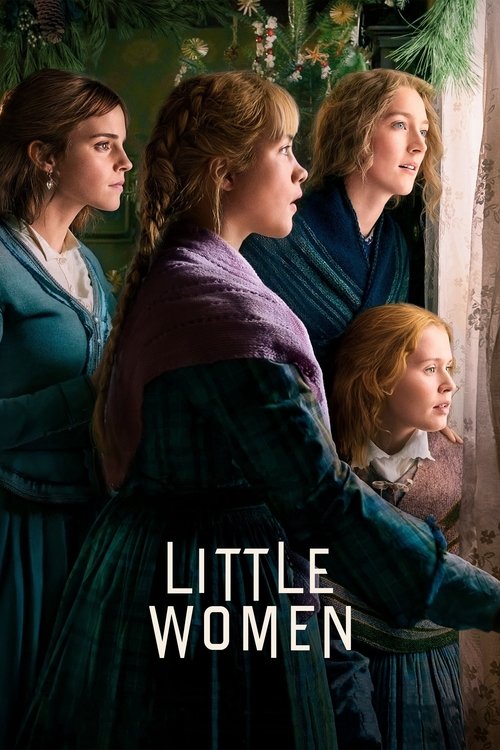
Little Women (2019)
Directed by Greta Gerwig
Partly · Woke-Adjacent
How we score movies →Consciousness Markers
Explicit celebration of female autonomy, particularly Jo's rejection of marriage and pursuit of writing career. Film emphasizes women's agency and diverse life paths.
Female-directed film with strong female leads, but predominantly white cast reflects source material without contemporary diversity expansion.
Feminist ideas articulated through character dialogue and thematic emphasis, particularly Jo's speeches, but emerges organically from narrative rather than preachy lecturing.
Family's economic constraints are addressed but romanticized rather than critiqued. No systemic critique of capitalism or wealth structures.
Straightforward adaptation of source material with modest contemporary framing but no significant historical revisionism.
Set in post-Civil War America but offers no meaningful engagement with racial themes or the Black experience. Historical moment treated as backdrop only.
No LGBTQ+ themes or representation present in the film.
No climate or environmental themes present.
No body positivity messaging or commentary present.
No neurodivergence representation or thematic engagement.


Synopsis
Four sisters come of age in America in the aftermath of the Civil War.
Why it received this score
Greta Gerwig's adaptation of Little Women presents itself as a contemporary feminist text, and in certain respects, it earns that designation. The film celebrates the autonomy of its four protagonists with genuine conviction, particularly through Saoirse Ronan's Jo March, whose pursuit of a literary career and resistance to conventional marriage represent a coherent thematic statement about female agency. Gerwig's direction emphasizes the sisters' different life choices without hierarchical judgment, a sensibility that feels deliberately calibrated for modern audiences attuned to discussions of female ambition and independence.
Yet the film's progressive sensibilities operate within a notably circumscribed sphere. It engages earnestly with gender and women's aspirations while remaining largely indifferent to race, class critique, or any other contemporary social consciousness markers. Set in post-Civil War America, the narrative treats the historical moment as mere backdrop, offering no interrogation of racial hierarchies or the social transformations of Reconstruction. The sisters' genteel poverty is presented as charming rather than systemically examined. The cast, almost uniformly white, reflects neither the actual diversity of 19th-century American life nor contemporary casting sensibilities.
The film succeeds at what it attempts, which is considerably narrower than it might have been. It is a fundamentally bourgeois feminist text, concerned with the marriage prospects and career ambitions of comfortable white women. This represents not a moral failing but rather a limitation in the scope of its social vision. The movie has absorbed certain feminist talking points of the 2020s without integrating them into a more expansive progressive framework.
Analysis generated by our Consciousness Algorithm
Critic Reviews
“[The novel's] themes have never not been fresh and they gleam here under the sympathetic and enlivening touch of Armstrong and her cast, who move through the events with sunny assurance and complete immersion in character. [21 Dec 1994]”
“Armstrong and screenwriter Robin Swicord have pared the work's sentimentality and bolstered its intellectual content, [21 Dec 1994]”
“A graceful, unsentimental, well-made movie.”
“Ms. Armstrong's Little Women, which has enough sugar to make your teeth sing, if not your heart. [29 Dec 1994]”