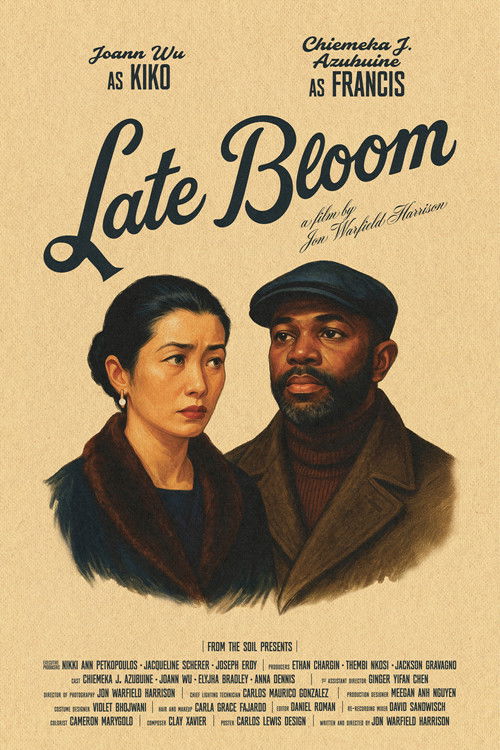
Late Bloom (2025)
Directed by Jon Warfield Harrison
Partly · Woke-Adjacent
How we score movies →Consciousness Markers
The film features a Black male lead and Asian female lead in a serious dramatic short. The casting appears intentional and central to the narrative, with both characters given substantive roles in processing trauma and loss.
The film explicitly centers a Black man's relationship to lost property and displacement, invoking gentrification as a subtext. The racial specificity of the protagonist's experience appears deliberate, though the film avoids preachy treatment.
Gentrification functions as the unstated economic engine of the narrative, implying critique of displacement and property dispossession. However, this remains implicit rather than explicitly articulated.
The film presents the female character as a supportive partner engaged in emotional labor, but this is portrayed as mutual vulnerability rather than a critique of patriarchal structures. The dynamic inverts some conventional gender roles without explicit feminist framing.
The film's treatment of gentrification and displacement engages with historical forces that displaced the protagonist's family, though this remains personal and localized rather than a systematic reframing of broader historical narratives.
The film's brevity and commitment to visual and emotional storytelling over exposition keep preachy energy relatively low. The progressive themes operate subtly rather than through explicit dialogue or messaging.
While the film engages with trauma and emotional processing, there is no specific reference to neurodivergence, autism, ADHD, or related conditions. Mental health engagement does not constitute neurodivergence representation.
The film contains no apparent body positivity messaging or commentary on appearance and physical standards. Bodies are presented naturally within the dramatic context.
No explicit LGBTQ+ themes are evident in the available plot description or reviews. The relationship between Francis and Kiko appears to be presented as heterosexual partnership.
There is no evidence of climate consciousness or environmental themes in the film. The natural setting serves as backdrop rather than subject matter.
Synopsis
The fog rests on top of a field nestled up against a secluded road, two individuals stand side by side as they survey the land. Francis, (43, Black man) is accompanied by his partner Kiko, (40, Asian woman). Together they retrace the steps of Francis' memory at the place where his home once stood. Francis seeks to express how the effects of childhood trauma have permeated into the present day, ultimately affecting their relationship. Through their togetherness they work to unpack these suppressed emotions in a way that's conducive to furthering their growth.
Why it received this score
Late Bloom operates in that curious register of contemporary indie cinema where social consciousness and genuine artistic ambition blur into something that requires careful unpacking. The film's central conceit, a Black man and Asian woman examining the site of his lost childhood home while processing intergenerational trauma, reads less as narrative choice and more as a deliberate assembly of cultural markers. The gentrification subtext, which appears to lurk beneath the surface, provides the material foundation for the emotional excavation. What saves this from pure aestheticization is the film's brevity and its commitment to the specific: at roughly eleven to twelve minutes, it resists the temptation to lecture, instead allowing the two characters to stand in companionable silence while confronting the material absence of home.
The film's progressive sensibilities emerge not from what it explicitly states but from what it assumes about its audience's capacity to hold multiple ideas simultaneously. The interracial partnership is presented as a given rather than a problem to be solved, which represents a significant departure from the therapeutic couple narrative that might have dominated a decade ago. The male character's vulnerability in processing trauma through emotional expression, combined with the female character's supportive presence, inverts certain conventional relationship dynamics without announcing the inversion. These elements exist in the film, though whether they constitute deliberate social commentary or simply the natural texture of contemporary artistic practice remains admirably ambiguous.
Where Late Bloom's progressive character becomes more insistent is in its treatment of trauma itself as a legitimate subject worthy of cinematic attention. The film treats emotional unpacking not as weakness but as work, a labor that requires partnership and presence. This orientation toward mental health as a serious matter of artistic concern places it firmly within contemporary cultural conversations about emotional intelligence and psychological awareness. The film does not shy away from its own cultural positioning, yet it also does not weaponize it. We are left with a short work that understands itself as part of a broader cultural moment while maintaining enough restraint to avoid becoming a mere instrument of that moment.
Analysis generated by our Consciousness Algorithm