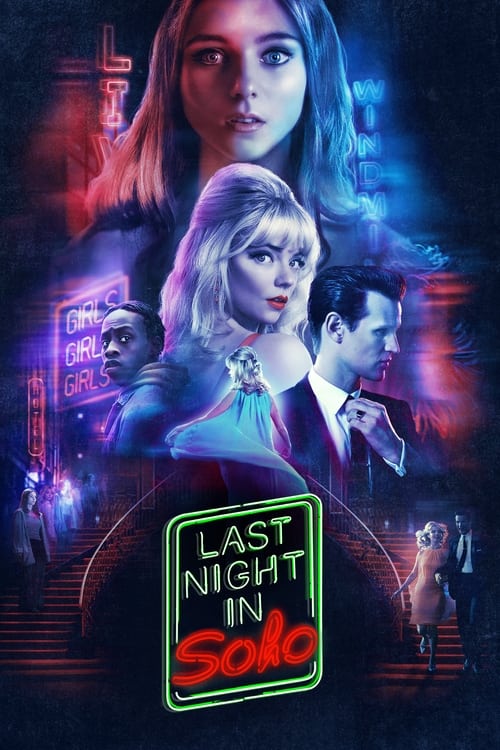
Last Night in Soho (2021)
Directed by Edgar Wright
Partly · Woke-Adjacent
How we score movies →Consciousness Markers
The film explicitly explores sexual exploitation, predatory behavior, and the systemic abuse of women in entertainment. Co-written by Krysty Wilson-Cairns, it centers female agency and trauma as the core narrative concern.
Two strong female leads carry the narrative, with a diverse supporting cast including Black British actors and older women. However, the film does not foreground representation as a thematic concern; it appears as natural casting rather than deliberate diversification.
The film deliberately revises nostalgic mythologies of 1960s London, stripping away glamour to reveal exploitation. It challenges the rose-tinted narrative of the Swinging Sixties by centering women's experiences of abuse.
The film critiques the entertainment industry's commodification of women and predatory economics, but this critique remains focused on gendered exploitation rather than broader capitalist systems.
While the film engages with feminist themes, it does so primarily through narrative and visual language rather than explicit preachiness. The horror framework allows for thematic exploration without overt preachiness, though some contemporary audiences may detect a moralizing undertone.
The cast includes actors of color in supporting roles, but the film does not engage with racial themes or historical racial dimensions of 1960s London in any substantive way.
No LGBTQ+ themes, characters, or representation are present in the film.
No climate change or environmental themes appear in the film.
No body positivity themes or commentary on body standards are present in the film.
No neurodivergent characters or themes are present in the film.


Synopsis
A young girl, passionate about fashion design, is mysteriously able to enter the 1960s where she encounters her idol, a dazzling wannabe singer. But 1960s London is not what it seems, and time seems to be falling apart with shady consequences.
Why it received this score
Edgar Wright's "Last Night in Soho" arrives as a considerably self-aware attempt to center female trauma and exploitation within the glossy veneer of 1960s nostalgia. The film functions as both love letter to the era and corrective, stripping away the rose-tinted mythology of Swinging London to reveal the predatory structures beneath. Thomasin McKenzie and Anya Taylor-Joy carry the narrative with genuine weight, and the decision to co-write with Krysty Wilson-Cairns signals Wright's deliberate engagement with feminist storytelling, marking a notable departure from his earlier filmography.
The film's progressive sensibilities rest primarily on its sustained examination of sexual exploitation and gendered violence. The 1960s sequences do not simply showcase women as decorative period details but instead interrogate how women's ambitions were systematized into commodification and abuse. There is no male savior narrative here; the horror emerges from institutional sexism and predatory economics. The contemporary framing, in which McKenzie's character grapples with inherited trauma and generational cycles, suggests awareness of how these historical injustices reverberate into the present.
Yet the film's cultural consciousness remains somewhat surface-level in its application. The horror operates within conventional genre frameworks rather than interrogating them. The narrative stops short of deeper structural critique, preferring to locate menace in individual perpetrators rather than systemic apparatus. For all its careful attention to female suffering, the film ultimately offers catharsis through personal agency rather than collective reckoning. It is, in other words, a contemporary work about historical oppression, conscious of its own moment, but not necessarily transformed by that consciousness.
Analysis generated by our Consciousness Algorithm
Critic Reviews
“Left behind is [Wright's] trademark hyperactive editing and insistent post-modernism; in its place is flowing movement and intense emotion. ”
“Last Night in Soho is an immensely pleasurable film that delights in playing with genre, morphing from time-travel fantasy to dark fairy tale, from mystery to nightmarish horror in a climax that owes as much to ’60s Brit fright fare as to more contemporary mind-benders.”
“It’s a blast. Last Night In Soho is the kind of good time which isn’t over until someone’s either crying or bleeding. And oh, how we’ve all missed those nights!”
“Depraved, delirious, and downright stupid, Last Night in Soho is two hours of amateurish drivel by B-movie director Edgar Wright (Baby Driver, Shaun of the Dead) that pretends to be half-retro Swingin’ Sixties comedy and half-horror thriller. ”