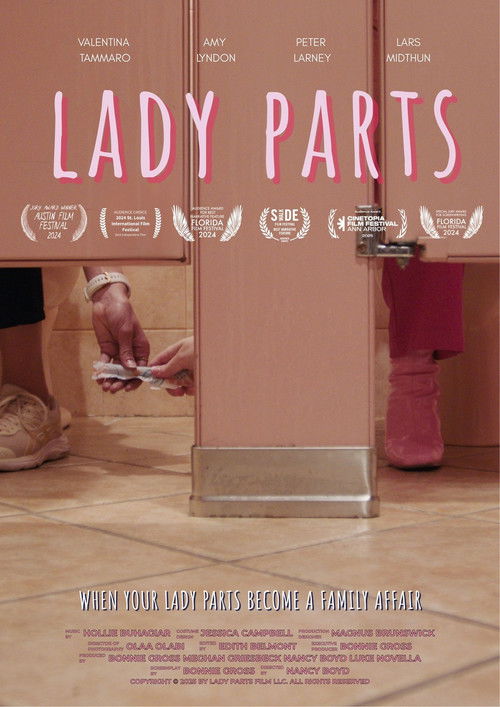
Lady Parts (2026)
Directed by Nancy Boyd
Yes · Woke
How we score movies →Consciousness Markers
The film's entire thesis is feminist advocacy: it frames a woman learning to say 'vagina' aloud as a metaphor for self-advocacy in all areas of life, explicitly targets the cultural shame imposed on women regarding their own bodies, and positions access to proper medical treatment as a gendered justice issue.
The film is structurally a body-positivity manifesto directed at female anatomy specifically. Its stated mission to erase shame around vulvar health, normalize clinical vocabulary, and celebrate bodily self-knowledge places it squarely in this tradition.
The film has a stated educational mission and an explicit thesis sentence built directly into its plot summary. When a film's logline is also its lesson plan, the lecture energy is difficult to separate from the dramaturgy.
The film is directed by women, written by a woman, and centers entirely on a female protagonist's bodily experience. The supporting cast includes diverse ensemble members, though the film's representation emphasis is primarily gender-based rather than broadly intersectional.
The film touches on women's difficulty receiving proper medical treatment, which carries an implicit critique of a healthcare system that historically dismisses female pain. This is not foregrounded as an anti-capitalist argument, but the subtext is present.
The film consciously subverts the cultural trope of the clueless or squeamish father regarding women's health, positioning this as a corrective to pop-culture norms. This is a mild form of narrative revisionism, not historical revisionism in the traditional sense.
The film uses the inclusive phrasing 'people with vaginas' in its promotional materials, a linguistic marker with specific currency in contemporary LGBTQ+ discourse. No LGBTQ+ characters or storylines are documented in the available material.
The cast includes performers of color in supporting roles, but no racial consciousness themes are documented in the film's narrative or critical coverage. The diversity appears incidental to the story's concerns.
No climate or environmental themes are present in this film about post-surgical recovery and family dynamics.
No neurodivergence themes, characters, or framing are present in the available material.


Synopsis
Based on writer & producer Bonnie Gross's true story, Lady Parts is a dramedy feature film where a young woman's sex life becomes a family affair when she has to undergo a vulvar vestibulectomy. Her loving, but overbearing parents help her through recovery (despite her cringing) and learn that saying "vagina" loud and proud is the first step to advocating for herself in all aspects of her life.
Why it received this score
There is a genre of film in which the central character learns, over the course of ninety or so minutes, to say a word. "Lady Parts" is such a film, and the word is "vagina." We are invited to understand this as a journey. The protagonist undergoes a vulvar vestibulectomy, recovers with the enthusiastic assistance of her parents, and arrives at the far shore of the narrative in possession of a clinical vocabulary and, by extension, the full suite of self-advocacy skills required to navigate modern womanhood. The film's promotional materials describe this arc with a directness that leaves little room for interpretation: saying the word loud and proud is the first step to advocating for herself in all aspects of her life. All aspects. The gynecological and the existential, united at last.
To its credit, the film draws on a genuine medical reality. Vulvodynia and related conditions are chronically underdiagnosed, undertreated, and dismissed by a healthcare system with a long institutional history of not taking female pain seriously. These are documented facts, not talking points, and a film that dramatizes them is doing legitimate work. The body-positivity framing is high, the feminist scaffolding is load-bearing, and the lecture energy is considerable. What keeps this from the upper registers of the scale is its essential warmth: this is a family comedy about embarrassment and love, and the sermonizing is delivered with enough self-awareness to soften the edges. The film is not interested in making the audience feel guilty. It is interested in making the audience comfortable saying a word. That is a narrower ambition than it first appears.
The creative team, both women drawing from lived experience, have produced something that sits at an interesting intersection of personal confession and public health messaging. The result is earnest in the specific way that films with a mission tend to be earnest: the story exists in service of the thesis, and the thesis was written before the story. As cultural artifacts go, it is a very 2026 object. It knows exactly what it is, it is proud of what it is, and it would like you to be proud of it too.
Analysis generated by our Consciousness Algorithm