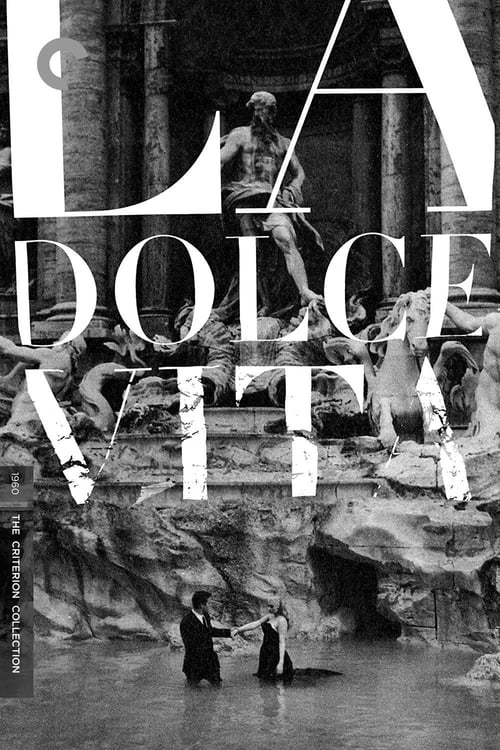
La Dolce Vita (1960)
Directed by Federico Fellini
No · Ultra Based
How we score movies →Consciousness Markers
While the film critiques consumer culture and the spiritual emptiness of wealth, this critique is philosophical rather than ideological. There is no systemic analysis or call for structural change.
The cast is entirely white and Italian, reflecting no diversity. Female roles are limited to romantic interests and objects of male desire.
The film communicates its critique through visual poetry and narrative structure rather than through preachy dialogue, resulting in low explicit messaging but high artistic intention.
Women are consistently portrayed as objects of male desire and consumption. The narrative is entirely centered on Marcello's perspective, with female characters serving as mirrors for his own spiritual crisis.
There is a brief scene involving a gay male character, but it is presented as comic relief and reflects period attitudes of mockery rather than genuine representation.
The film contains no engagement with racial consciousness or representation of minorities. It exists within an entirely white Italian social world.
Climate concerns are entirely absent from the film's thematic concerns.
The film presents a narrow, conventional standard of beauty with no engagement with body diversity or body positivity frameworks.
There is no representation of neurodivergence or disability in the film.
The film does not engage in historical revisionism or reinterpretation of historical events.
Synopsis
Episodic journey of journalist Marcello who struggles to find his place in the world, torn between the allure of Rome's elite social scene and the stifling domesticity offered by his girlfriend, all the while searching for a way to become a serious writer.
Why it received this score
Federico Fellini's "La Dolce Vita" remains a towering achievement of post-war cinema, a film of such formal sophistication and narrative ambition that it continues to reward repeated viewing across the decades. The film's central preoccupation is the spiritual bankruptcy of Rome's upper classes in the late 1950s, a society obsessed with consumption, celebrity, and the accumulation of empty pleasures. Marcello's journey through nightclubs, film sets, and high society functions as a descent into meaninglessness, each encounter revealing new layers of social artificiality.
Yet the film's critique of capitalism and consumer culture operates almost entirely on an aesthetic and philosophical register rather than through ideological commitment. Fellini shows us the disease without proposing the cure, and certainly without the explicit moral framework that contemporary social consciousness demands. The women in the film exist primarily as objects of desire and symbols of unattainable fantasy, reflecting the patriarchal assumptions of its era. Sylvia is not a character but a vision, a projection of male longing onto the figure of female beauty. The film makes no effort to complicate or interrogate this dynamic.
What remains undeniable is the film's artistic power. The famous swimming scene, the party sequences, the haunting final image of dead fish on a beach: these moments transcend their historical moment through sheer visual poetry. But transcendence through art is not the same as progressive social consciousness. "La Dolce Vita" is a masterpiece of cinema that happens to be fundamentally indifferent to the concerns of modern cultural awareness.
Analysis generated by our Consciousness Algorithm
Critic Reviews
“The movie is made with boundless energy. Fellini stood here at the dividing point between the neorealism of his earlier films (like "La Strada") and the carnival visuals of his extravagant later ones ("Juliet of the Spirits," "Amarcord'').”
“A brilliantly graphic estimation of a whole swath of society in sad decay and, eventually, a withering commentary upon the tragedy of the overcivilized. (Review of Original Release)”
“After nearly three hours Fellini's relentlessly enigmatic, non-committal approach leaves you wishing for something more than poignant imagery and moody, self-obsessed characters. (Review of original release)”