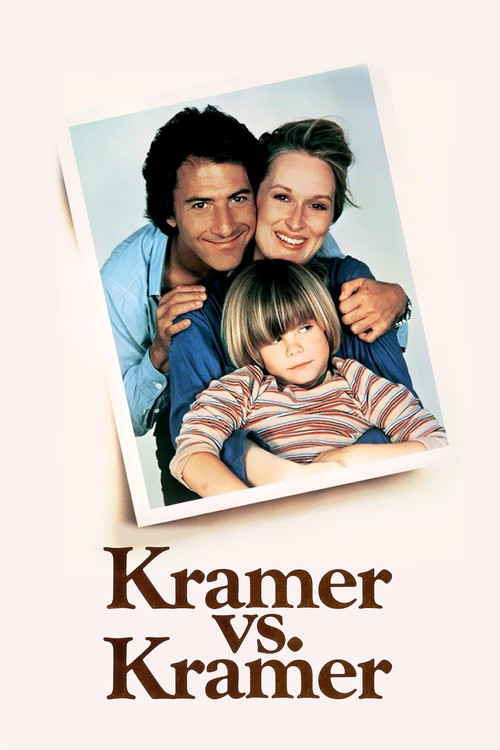
Kramer vs. Kramer (1979)
Directed by Robert Benton
No · Ultra Based
How we score movies →Consciousness Markers
The film permits a female character agency and prioritizes her own needs, which was somewhat progressive for 1979, but lacks contemporary feminist consciousness about systemic inequality.
The cast is entirely white and the film makes no attempt to examine or acknowledge this homogeneity. Representation is not a concern of the 1979 context.
While the film critiques workaholic capitalism through Ted's character arc, it resolves through individual redemption rather than systemic critique.
The film conveys its themes through dramatic action and emotional performance rather than explicit messaging or preachy dialogue.
No LGBTQ+ themes or characters are present. The film concerns itself exclusively with heterosexual family structures.
The film contains no racial consciousness whatsoever. Race is not addressed or acknowledged in any form.
Climate concerns are entirely absent from the film's narrative and thematic concerns.
Body positivity is not a consideration in the film. Bodies appear unremarkable and without comment.
No neurodivergent characters or themes are present in the film.
The film makes no attempt to revisit or reinterpret historical narratives.


Synopsis
Ted Kramer is a career man for whom his work comes before his family. His wife Joanna cannot take this anymore, so she decides to leave him. Ted is now faced with the tasks of housekeeping and taking care of himself and their young son Billy.
Why it received this score
Kramer vs. Kramer stands as a curious artifact from a pre-woke era, a film that engaged with progressive themes before the contemporary lexicon of social consciousness had fully calcified. The narrative permits both parents complexity, allowing Joanna to abandon domestic servitude in pursuit of self-actualization without the film condemning her, and depicting Ted learning the unglamorous logistics of childcare. This is earnest humanism, not cultural signaling. Meryl Streep's character refuses to be a passive victim of circumstance, claiming her own ambitions as legitimate. The film treats her sympathetically even as it centers Hoffman's journey of emotional growth.
Yet the film operates entirely within 1970s frameworks of gender relations and family structure. There is no interrogation of power systems, no acknowledgment that custody battles disproportionately harm certain communities, no celebration of diverse family formations beyond the nuclear unit. The child is a white boy. The professionals involved in the custody dispute are white. The film's emotional register is one of personal redemption through individual effort rather than structural critique. When Joanna testifies about her own needs, the film presents this as a confession rather than a righteous assertion, and Ted's final choice to prioritize his son reads as the correct moral outcome in a way that would feel uncomfortably deterministic to a contemporary audience.
Stripped of the sentimentality that has accumulated around it, the film is a competent domestic drama that treats its characters with dignity. It is not woke, nor should it be expected to be. It belongs to a different cultural moment entirely, one that valued personal agency and emotional honesty over the systematic interrogation of social categories that defines contemporary progressive sensibility.
Analysis generated by our Consciousness Algorithm
Critic Reviews
“Kramer vs. Kramer is a movie of good performances, and it had to be, because the performances can't rest on conventional melodrama.”
“Kramer vs. Kramer is one of the most sensitive and least judgmental film about relationships ever made in the United States.... One of the important films. [15 Dec 1979]”
“Kramer vs. Kramer is, essentially, a television movie that was raised into the feature category by the excellence of the execution.”
“Misogynistic claptrap about a divorced husband (Dustin Hoffman) fighting for the custody of and learning to cope with his little boy (Justin Henry) - a movie whose classy trimmings (including Nestor Almendros's cinematography) persuaded audiences to regard writer-director Robert Benton as a subtle art-house director.”