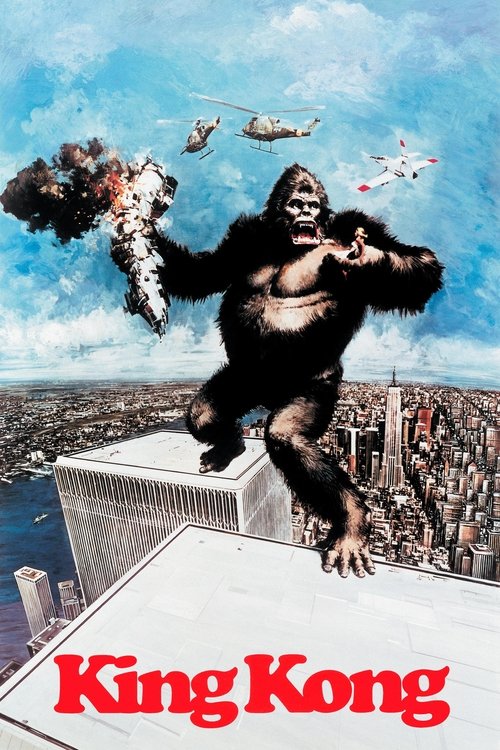
King Kong (1976)
Directed by John Guillermin
No · Ultra Based
How we score movies →Consciousness Markers
The cast is predominantly white with minimal representation. Indigenous characters are relegated to background roles with no names or development, treated as an undifferentiated mass.
Jessica Lange's character exists primarily to be rescued and protected. She has minimal agency and serves as a prize rather than a full participant in the narrative.
The film actively perpetuates colonial and racist imagery through its portrayal of indigenous peoples as savage obstacles. No critical examination of these dynamics is present.
While the film does not lecture explicitly, it broadcasts its colonial assumptions with such confidence that it borders on preachy in its naturalization of exploitation.
No LGBTQ+ themes or representation present in the film.
No environmental consciousness or climate themes are present. The oil company's activities are presented without moral commentary.
The film celebrates capitalist exploitation as spectacle. There is no critique of the commodification of nature or indigenous peoples.
No body positivity themes. Kong is presented as a monster to be feared and destroyed, not understood or accepted.
No representation of neurodivergence or disability in any meaningful way.
The film does not engage with or revise historical narratives. It presents colonial attitudes as natural and unremarkable.


Synopsis
An oil company expedition disturbs the peace of a giant ape and brings him back to New York to exploit him.
Why it received this score
The 1976 King Kong stands as a curious artifact of Hollywood's resistance to evolving social consciousness in the post-civil rights era. Produced during a period when the film industry was only beginning to grapple with its historical complicity in racial and gender stereotyping, this Dino De Laurentiis remake manages to feel actively hostile to progress. The film's depiction of the indigenous inhabitants of Skull Island retreats from even the limited improvements made in the original 1933 version, presenting them as faceless, threatening primitives existing solely as obstacles to be overcome by white American ingenuity. Jessica Lange's role as Ann Darrow offers minimal agency, confined largely to screaming and being rescued, a posture that renders her a passive ornament in a narrative fundamentally about masculine conquest and exploitation.
What emerges most strikingly is the film's refusal to interrogate its own colonial logic. The narrative celebrates the extraction of Kong as a resource, much as the oil company extracts petroleum, with the same moral vacuum. There is no irony, no critique, no suggestion that perhaps we should examine what it means to invade a remote island, capture its inhabitants' sacred creature, and display it as entertainment. The film treats this as straightforward adventure, worthy of spectacle and thrills. In this respect, it embodies a particular strain of mid-1970s American cinema that was becoming increasingly out of step with contemporary cultural conversations about imperialism, environmental destruction, and the commodification of the Other.
The casting of Jeff Bridges and Charles Grodin provides no counterweight to these dynamics. Both are afforded complexity and moral deliberation, while the native population exists in complete narrative darkness. This imbalance is not accidental. It reflects the filmmakers' fundamental assumptions about whose stories matter, whose perspectives merit development, and whose humanity warrants consideration. The film's spectacular technical achievements in depicting Kong himself only underscore this moral vacancy. We are invited to marvel at the craftsmanship while the underlying structures of exploitation remain unexamined and, crucially, uncriticized.
Analysis generated by our Consciousness Algorithm
Critic Reviews
“What a movie! This is how the medium seduced us originally.”
“One of the wonders of the holiday season.”
“Here is the jaw-dropping, eye-popping, heart-stopping movie epic we've been waiting for all year.”
“On its own terms, the film is overlong, repetitive and lacks impact. Even if this were the first gorilla-in-love movie ever made, audiences would come away vaguely dissatisfied, suspecting there was an intriguing idea buried somewhere in here, but it didn't quite come off.”