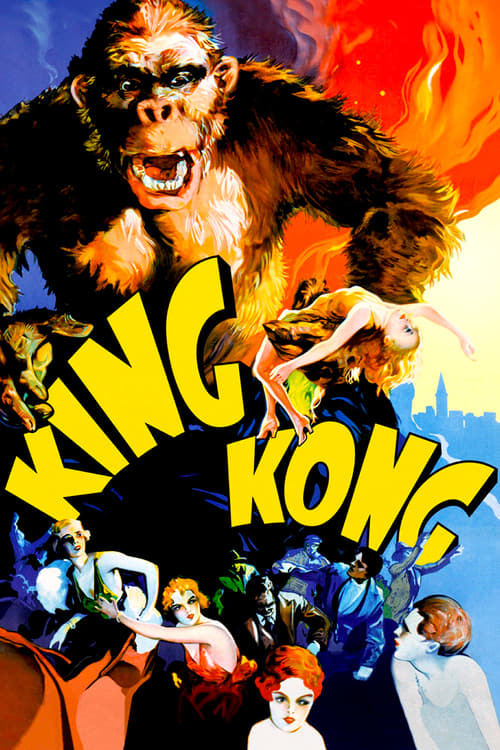
King Kong (1933)
Directed by Merian C. Cooper
No · Ultra Based
How we score movies →Consciousness Markers
The film contains troubling racial elements by modern standards, but these reflect unexamined period attitudes rather than conscious engagement with racial themes.
The cast is entirely white, with indigenous islanders presented as background extras. This reflects 1933 Hollywood practice, not contemporary casting approaches.
No LGBTQ+ themes or representation present. The film is entirely heteronormative by default.
Fay Wray's Ann Darrow is a classic damsel-in-distress character. While she survives and has agency by the end, the film contains no feminist consciousness.
No environmental themes or climate consciousness present in the narrative.
While Denham's exploitation could be read as critique, the film makes no anti-capitalist statements.
No body positivity themes present. Kong is presented as a monster to be destroyed.
No representation of neurodivergence or disability consciousness in the film.
The film makes no attempt to revise historical narratives or present alternative historical perspectives.
The film prioritizes spectacle and narrative momentum over preachy messaging or exposition.


Synopsis
Adventurous filmmaker Carl Denham sets out to produce a motion picture unlike anything the world has seen before. Alongside his leading lady Ann Darrow and his first mate Jack Driscoll, they arrive on an island and discover a legendary creature said to be neither beast nor man. Denham captures the monster to be displayed on Broadway as King Kong, the eighth wonder of the world.
Why it received this score
King Kong stands as a monumental achievement in practical effects and creature design, a film that essentially invented the modern monster movie and remains technically impressive nearly a century later. To evaluate it through the apparatus of contemporary progressive sensibilities would be somewhat akin to assessing a medieval manuscript for its failure to address intersectionality. The film is a product of 1933 Hollywood, where Fay Wray's role as a damsel in distress was simply the default template for female characters, not a deliberate statement against feminism. The indigenous inhabitants of Skull Island are depicted with the casual dehumanization typical of the era, reflecting the racism embedded in adventure narratives of that period, but this was the water in which all Hollywood films swam.
What we find is a work that, while containing elements that modern criticism can interrogate for their troubling implications, cannot be meaningfully scored on markers designed to measure contemporary cultural choices. The film does not attempt progressive representation, nor does it attempt its opposite in a self-aware way. It simply exists as a monument to what cinema was capable of achieving with ingenuity and ambition in an era before such cultural frameworks existed in the form we now recognize.
To apply contemporary scoring criteria to pre-modern cinema is to confuse historical analysis with cultural criticism. King Kong deserves recognition as a technical and narrative achievement, but scoring it on a scale designed to measure 2020s cultural sensibilities would be an exercise in category error rather than genuine assessment.
Analysis generated by our Consciousness Algorithm
Critic Reviews
“What a movie! This is how the medium seduced us originally.”
“One of the wonders of the holiday season.”
“Here is the jaw-dropping, eye-popping, heart-stopping movie epic we've been waiting for all year.”
“On its own terms, the film is overlong, repetitive and lacks impact. Even if this were the first gorilla-in-love movie ever made, audiences would come away vaguely dissatisfied, suspecting there was an intriguing idea buried somewhere in here, but it didn't quite come off.”