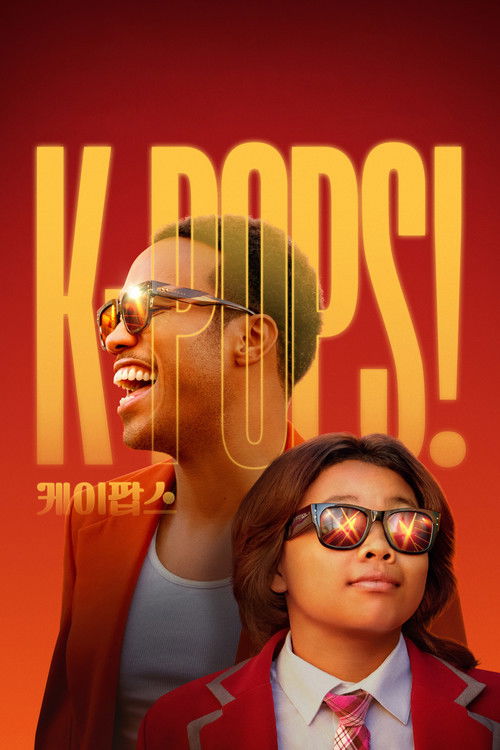
K-Pops! (2026)
Directed by Anderson .Paak
Partly · Woke-Adjacent
How we score movies →Consciousness Markers
Strong multicultural casting including Korean and Korean-American actors alongside Black actors. The film centers on biracial and diaspora identity.
The film explicitly explores Black American and Korean cultural identity through the lens of a biracial protagonist and his heritage. However, it maintains a largely celebratory rather than critical stance.
The narrative criticizes the protagonist's initial desire to capitalize on his son's stardom, but the film itself is a vehicle for celebrity and does not interrogate systemic industry problems.
While the film explores cultural themes, reviews describe it as 'charming' and 'uncynical' rather than preachy. However, its exploration of heritage carries some pedagogical weight.
The film touches on diaspora and cultural history through personal narrative, but does not engage in systematic historical revisionism or reframing.
Limited feminist elements. Yvette Nicole Brown appears in the cast but her role and agency are not central to the narrative structure.
No LGBTQ+ themes or characters are present in the film's narrative or cast as documented.
No climate-related themes or messaging appear in the film's plot or thematic concerns.
No evidence of body positivity messaging or critique of beauty standards in available information about the film.
No neurodivergent representation or themes are present in the documented narrative or cast information.
Synopsis
A washed-up musician travels to Korea to write for K-pop stars, discovering that his long-lost son is set to front one of the country's hottest new groups. He then jumps at the opportunity to capitalize on his son's stardom for his own renaissance, but learns that fatherhood is much more fulfilling and meaningful than stardom.
Why it received this score
K-Pops! arrives as a curious artifact of contemporary cinema, a film so earnestly committed to exploring cultural bridge-building that it occasionally forgets to examine the terrain it crosses. Anderson .Paak's directorial debut centers on a Black American musician reconnecting with his Korean heritage through his biracial son, a premise that could have yielded either genuine cross-cultural dialogue or the kind of superficial multiculturalism that treats representation as a checkbox. The film settles somewhere in the middle, offering charming moments of family reconciliation while maintaining a studied distance from any real critique of either the K-pop industrial complex or the deeper tensions embedded in American-Korean cultural exchange.
The film's progressive sensibilities emerge primarily through its casting and thematic emphasis on heritage and familial bonds rather than through structural interrogation. We are given an ensemble that includes Korean and Korean-American characters, and the narrative takes care to situate these individuals within a cultural context. Yet the movie seems more interested in feel-good reconciliation than in the harder work of examining power dynamics, cultural appropriation, or the ways in which both the music industry and diaspora identity can be weaponized. It is, in the end, a film about fatherhood that happens to be set within K-pop rather than a film about K-pop's cultural implications.
The result is a moderately progressive entertainment that wears its social consciousness lightly, almost apologetically. For those seeking genuine cultural interrogation, this is likely insufficient. For those seeking a joyful family story with multicultural representation, it may hit its target.
Analysis generated by our Consciousness Algorithm
Critic Reviews
“"Adorable" is not an adjective I’ve often applied to a movie, but “K-Pops!” earns it. It will play well on the big screen, and make you forget about your troubles for two hours.”
“With energetic dance sequences and a heartwarming bond between a father and a son, K-Pops! is a bundle of joy that rarely misses a beat.”
“It’s a testament to .Paak’s own journey, and the seemingly healthy relationship with both this genre of music and his child, that this movie eschews so many of those struggle-bus tropes. I just wish it translated to something with a bit more oomph, rather than another blandly sincere family film.”
“The intended message is that B.J. must stop chasing the spotlight to let his son be the star. But his character can’t do it and neither can he. In fairness, the title is a clue that technically the focus was never Korean music. The story was always about Pops learning to be a dad.”