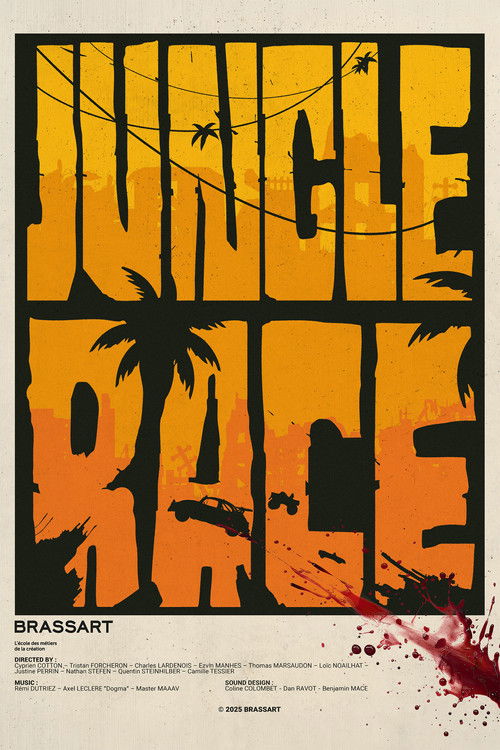
Jungle Race (2025)
Directed by Nathan Stefen, Camille Tessier, Cyprien Cotton, Charles Lardenois, Thomas Marsaudon, Justine Perrin, Tristan Forcheron, Quentin Steinhilber, Loic Noailhat, Ezvin Manhes
No · Ultra Based
How we score movies →Consciousness Markers
The post-apocalyptic island setting could suggest environmental concerns, but this appears to be aesthetic choice rather than genuine climate commentary or advocacy.
Animal characters rather than human actors, so traditional representation casting is largely moot. No discernible diversity politics in voice casting or character design.
A competitive race between animals might obliquely critique competition itself, but this seems unintentional and minimal.
No evidence of LGBTQ+ themes, representation, or narrative elements in the available information about this animation project.
No indication of feminist themes or gender-conscious storytelling in this technical animation exercise.
The post-apocalyptic animal race scenario does not engage with racial themes or consciousness in any identifiable way.
Body positivity concerns are not applicable to a film about animal characters in a technical animation project.
No evidence of neurodivergent representation or themes in this student animation work.
This is a fictional animal race, not a historical narrative requiring revisionism or reinterpretation.
The film does not appear to lecture its audience about social or political matters, remaining focused on technical animation demonstration.
Synopsis
A 3D animated short film about a race between monkeys on a post-apocalyptic island, created as a graduation project by ten animation students.
Why it received this score
Jungle Race presents itself as a technically accomplished student animation project, a thesis exercise in 3D rendering rather than a work of intentional social commentary. The film concerns itself primarily with the mechanics of animation, the physics of motion, and the logistics of depicting a competitive race between anthropomorphic primates in a degraded landscape. These are legitimate pursuits for a graduating cohort of digital artists, and we should not mistake technical competence for cultural engagement.
The post-apocalyptic setting, while visually evocative, appears to function as mere aesthetic backdrop rather than as commentary on environmental collapse or the failures of human civilization. The animal characters race without apparent irony or deeper meaning, suggesting the film's creators were focused on demonstrating their mastery of character rigging, particle effects, and environmental modeling. There is nothing wrong with this, of course, but it does mean the film remains largely indifferent to the progressive sensibilities that might have elevated it to a higher register of social consciousness.
What minimal progressive markers emerge seem accidental rather than deliberate. The cast list, while somewhat opaque in its naming conventions, does not suggest any particular commitment to representation politics. The film's narrative vacuum, its complete absence of plot synopsis, suggests a work concerned with form over message, with technical demonstration over ideological positioning. For a student project, this is arguably the correct priority. It remains, however, almost entirely absent of the cultural markers we have come to expect from contemporary media.
Analysis generated by our Consciousness Algorithm