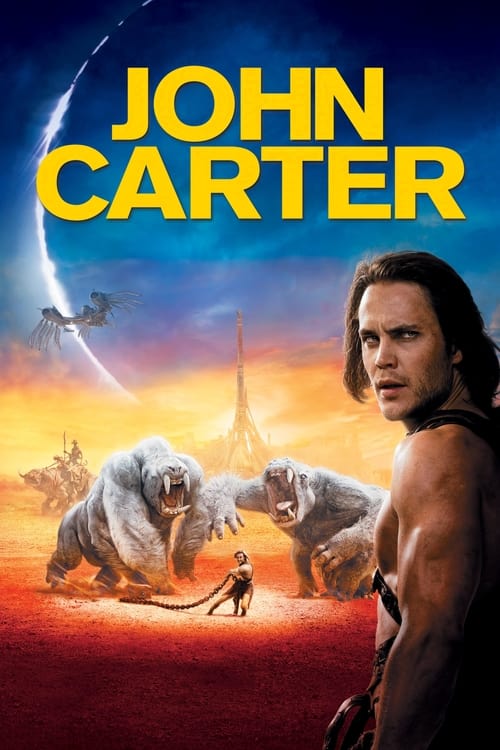
John Carter (2012)
Directed by Andrew Stanton
No · Ultra Based
How we score movies →Consciousness Markers
Lynn Collins leads as Dejah Thoris, a strong female character, though the broader cast remains predominantly white with limited diversity in both human and alien casting.
Dejah Thoris demonstrates agency and intelligence, but ultimately functions as a romantic interest and plot device for the male protagonist's arc.
Barsoom's environmental collapse provides narrative backdrop, but climate concerns are treated as mere world-building rather than thematic commentary.
Minimal expository dialogue about social or moral issues; the film functions as straightforward action-adventure entertainment.
No LGBTQ+ themes, characters, or representation present in the film.
The film does not engage with racial themes or consciousness in any meaningful way.
No anti-capitalist or class-consciousness themes are evident in the narrative.
No body positivity themes or representation are present.
No representation of neurodivergent characters or themes.
Based on early 1900s pulp fiction, the film does not engage in revisionist history of real events.


Synopsis
John Carter is a war-weary, former military captain who's inexplicably transported to the mysterious and exotic planet of Barsoom (Mars) and reluctantly becomes embroiled in an epic conflict. It's a world on the brink of collapse, and Carter rediscovers his humanity when he realizes the survival of Barsoom and its people rests in his hands.
Why it received this score
John Carter represents a curious artifact of early 2010s science fiction filmmaking, a $300 million adaptation of century-old pulp source material that arrived at a moment when contemporary audiences were beginning to expect different things from their blockbusters. The film's construction of an alien world, while visually ambitious for its time, remains largely indifferent to questions of representation and social consciousness that would soon become inescapable in mainstream cinema. Lynn Collins' Dejah Thoris operates with a degree of agency that distinguishes her from purely ornamental female characters, yet the film cannot resist reducing her primarily to love interest and motivation for the male protagonist's redemptive arc.
The broader narrative architecture reveals the film's fundamental distance from contemporary progressive sensibilities. Barsoom's environmental catastrophe functions as mere backdrop rather than thematic engine, a dying world whose collapse demands rescue but not examination. The casting remains monochromatic in ways that feel notably unremarkable for 2012 but would generate scrutiny in retrospective analysis. The green-skinned alien species, despite their otherworldly appearance, receive no meaningful characterization that might invite interpretation as allegory for otherness or marginalization.
What emerges most clearly is a film operating according to an older entertainment calculus, one that treated spectacle and adventure as sufficient unto themselves. There is no lecture energy here, no preachy dialogue about justice or inclusion. The film simply does not concern itself with these questions at all. In this respect, John Carter functions as a pure product of its source material's early twentieth-century assumptions, updated with modern visual effects but not modern consciousness.
Analysis generated by our Consciousness Algorithm
Critic Reviews
“The achievement of John Carter is that it takes the elements worn to nubs by everything from "Star Wars" to "Avatar" to TV's "Fringe" and makes them fresh again.”
“Old-school "Gosh, wow!" sense-of-wonder filmmaking is in short supply in these anxious days, and John Carter (of Mars!) left me with my disbelief in suspended animation and once or twice with goosebumps dotting my arms. And that's enough for me.”
“Rather than trying to overwhelm viewers by overloading the senses, John Carter's effects strive to create something new using as their foundation a book that's fired imaginations for the past century.”
“As film theorist Siegfried Kracauer once wrote, to paraphrase, art often blooms in the most hostile soil. No such luck here. ”