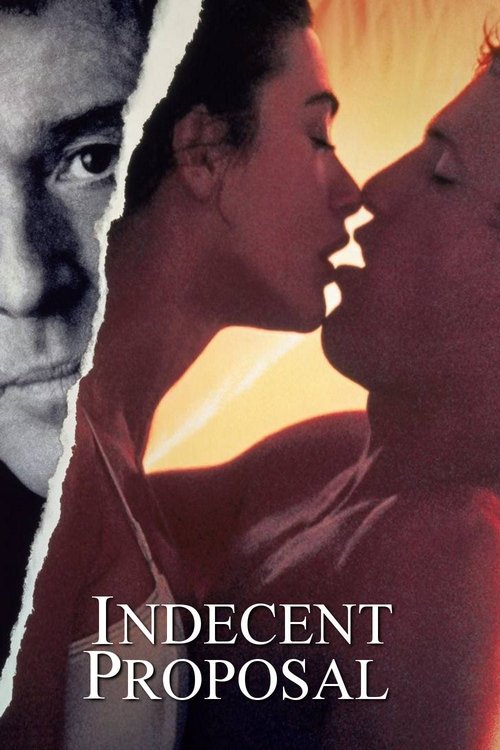
Indecent Proposal (1993)
Directed by Adrian Lyne
No · Ultra Based
How we score movies →Consciousness Markers
Demi Moore carries the film as the central object of desire, but the narrative remains firmly male-centered. Her agency is minimal and her character exists primarily as a commodity to be negotiated between men.
The film contains some moral hand-wringing about the ethics of the proposal itself, but it never develops into preachy preaching. The tension remains largely dramatic rather than pedagogical.
While the film depicts wealth and luxury, it does not critique capitalism itself. Rather, it romanticizes the wealthy protagonist and presents wealth as a vehicle for moral testing, not exploitation.
The film's treatment of its female lead is fundamentally transactional. Diana is reduced to her sexuality and exists as a prize within the central transaction, offering little in the way of progressive sensibilities.
No LGBTQ+ representation or themes are present in the film. The narrative is entirely heterosexual in its framing and concerns.
The film contains no meaningful engagement with racial themes or consciousness. The cast reflects the era's default whiteness without commentary or awareness.
Climate concerns are entirely absent from this romantic drama set in Las Vegas and Los Angeles. No environmental consciousness is present.
The film is constructed as a voyeuristic fantasy centered on Demi Moore's body. There is no body positivity present, only the male gaze and aesthetic standardization.
No representation of neurodivergence or disability is present in the film. The characters are presented without such considerations.
This is a contemporary drama with no historical setting or revisionist claims. No anachronistic reframing of history occurs.


Synopsis
John Gage offers a down-on-his-luck yuppie husband $1 million for the opportunity to spend the night with the man's wife.
Why it received this score
Adrian Lyne's 1993 "Indecent Proposal" arrives as a peculiar artifact of pre-Clinton decadence, a film that mistakes moral ambiguity for depth while constructing itself entirely around the commodification of a woman's body. The premise, which unfolds as a contemporary fairy tale for the financially desperate, offers a billionaire (Robert Redford) one million dollars to spend a single night with the wife (Demi Moore) of an architect (Woody Harrelson) facing foreclosure. The film treats this scenario as a serious moral quandary, when in fact it is merely a high-end transaction dressed in romantic language.
What proves most instructive about the film is its complete inability to imagine Diana as anything other than an object of transaction. Her consent matters only insofar as it facilitates the plot mechanics. The narrative focuses almost entirely on the men's emotional states, their jealousies, their wounded pride. Diana exists in the spaces between their conversations, a beautiful vessel for their anxieties about masculinity and worth. The film presents itself as exploring the boundaries of love and commitment, but it actually explores only the boundaries of male possession and control. No progressive consciousness enters this equation.
The film's box office success (it grossed over $300 million worldwide) speaks more to the power of Redford's star appeal and Lyne's visual sophistication than to any cultural merit. It remains a document of 1990s attitudes toward gender, wealth, and desire, interesting primarily as a historical marker of what counted as morally serious cinema before the internet altered our discourse around representation. We can recognize the film's technical competence while acknowledging its complete indifference to the humanity of its female lead.
Analysis generated by our Consciousness Algorithm
Critic Reviews
“With a shamelessly cliched script by Amy Holden Jones (based on a novel by Jack Engelhard) that includes a speech plagiarized from Citizen Kane, the results are only for those who can take fare like "Valley of the Dolls" with a straight face and want to see Redford play Jay Gatsby again.”
“The movie is ingenious in the way it surrounds its essentially crass subject matter with a camouflage of romantic scenery.”
“Indecent Proposal is as relentlessly entertaining as it is silly--so shamelessly over the top that you watch in a mixture of horror and delight as the drama unfolds toward a climax that is truly mind-boggling.”
“In Adrian Lyne's latest monstrosity, love takes on money -- and loses. Not necessarily in the story, of course. This is a Hollywood movie. I'm talking between the lines.”