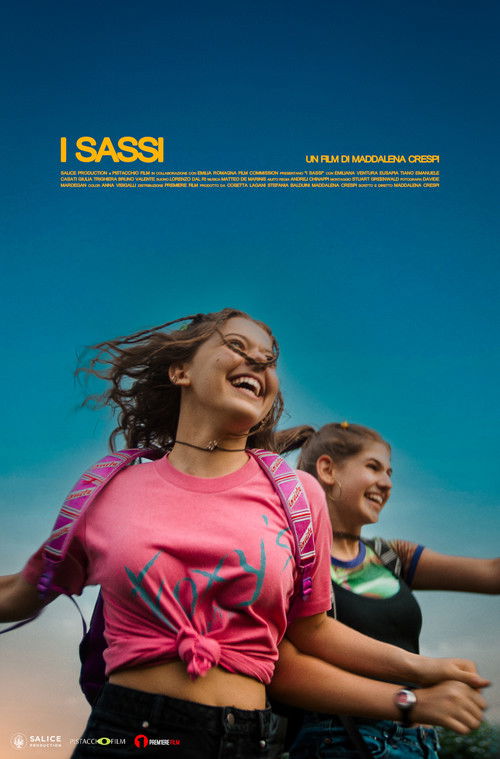
I Sassi (2026)
Directed by Maddalena Crespi
Partly · Woke-Adjacent
How we score movies →Consciousness Markers
The core relationship between the two girls contains elements of desire and intense emotional connection that can be read through a queer lens. The film's treatment avoids both exploitation and sanitization, presenting the complexity of adolescent female sexuality.
The film centers two teenage girls as primary subjects and employs young actresses in authentic roles. However, without evidence of deliberate diversity casting beyond gender, the representation remains focused on this single axis.
The girls are centered as subjects with interior lives, and the film acknowledges male predation and boundary violations. Yet the narrative's ambiguity about the girls' relationship and their ultimate act complicates a straightforward feminist reading.
The film maintains artistic ambiguity rather than preachy clarity, allowing viewers to interpret the girls' relationship and choices without explicit moral instruction. Some analytical distance from overt messaging, though the thematic content is not subtle.
As a film about teenage girls and desire, the work likely engages with the body as a site of meaning. However, without access to the complete film, it is unclear whether this engagement reflects body positivity or remains within conventional frameworks.
No evidence suggests the film explores neurodivergence or disability. The focus on emotional and psychological states does not appear to extend to these specific categories of representation.
The film's focus on adolescent psychology and landscape does not suggest engagement with capitalist critique or class analysis. No evidence of anti-capitalist themes in the available information.
The film is a contemporary work set in the present day with no apparent engagement with historical narrative or revisionist approaches to established historical events.
While the river landscape features prominently in the narrative, there is no indication that environmental themes drive the story or that climate consciousness informs the film's worldview.
No evidence in available materials suggests the film engages with racial or ethnic themes beyond the Italian geographical setting. This marker appears largely absent from the work's concerns.
Synopsis
Alessandra and Elisa are fifteen, bound by an intense connection that shifts between closeness, desire, and subtle jealousy. Elisa is about to move abroad, and the looming distance charges every gesture with new weight. They tease, provoke, and cling to each other, as if holding on and pushing away were the same thing. What they can't express surfaces in silences, in glances, in the fragile balance between them. Over the course of a long afternoon, following the path of a river, they drift along the edges of their world: boys who bully, men who blur boundaries, glimpses of an adult world they observe without fully understanding. In that uncertain space - shaped by fear, confusion, and desire - something cracks. An extreme act begins to take shape, driven by something deep, unspoken, and unresolved.
Why it received this score
Maddalena Crespi's "I Sassi" arrives as a contemplative Italian short that treats the murky territory of adolescent female desire with the kind of formal precision usually reserved for art cinema. The film concerns itself primarily with two fifteen-year-old girls whose relationship contains all the contradictions of that age: intimacy and aggression, connection and rupture, the desire to hold and to push away. Crespi does not sentimentalize this material, nor does she exploit it in the style of more questionable predecessors in Italian cinema. Instead, she positions the girls' experience within a landscape populated by bullying boys and predatory men, making clear that their emotional turbulence exists in relation to external threats and boundary violations. The film's cultural awareness manifests not through explicit messaging but through structural choices: the girls are centered as subjects rather than objects, their interior lives given weight and complexity.
What complicates the picture is the film's investment in ambiguity regarding the nature of the girls' connection and the "extreme act" that emerges from it. The overview hints at something darker, suggesting that their relationship contains elements of obsession and mutual harm rather than simple affection. This refusal to resolve the ethical dimensions of their bond into clean progressive sentiment is itself a kind of cultural statement, though not necessarily one that aligns cleanly with contemporary sensibilities. The film appears interested in psychological realism over ideological clarity, which paradoxically grants it more cultural consciousness than a more preachy approach might achieve.
The short's representation exists in the tradition of Italian cinema's ongoing discomfort with female adolescence and desire, yet Crespi seems to be working against that tradition rather than within it. Her casting of actual teenagers, her use of landscape as psychological space, and her refusal to resolve the girls' story into either triumph or tragedy all suggest an artist attuned to the complexities of how young women are perceived and positioned in contemporary culture. Whether this amounts to sufficient progressive consciousness or merely to artistic seriousness remains a matter of interpretive debate.
Analysis generated by our Consciousness Algorithm