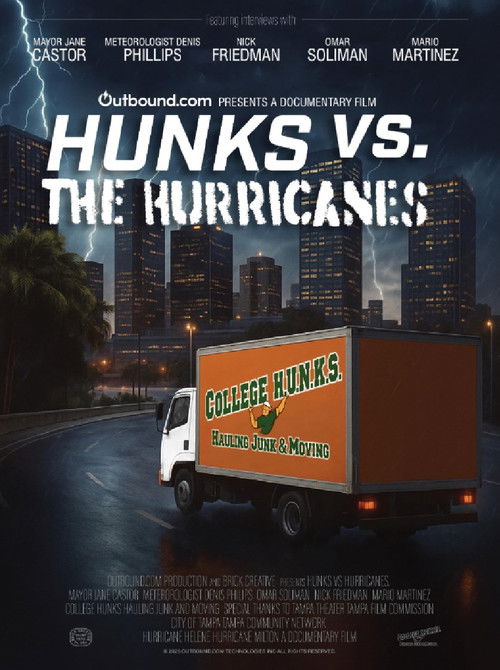
HUNKS vs. The Hurricanes (2026)
Directed by Aaron White
No · Ultra Based
How we score movies →Consciousness Markers
The film documents the aftermath of two hurricanes, and climate change is the implicit backdrop of intensifying storm seasons. However, the film appears to focus on response and resilience rather than delivering a climate advocacy message.
The documentary features a demographically mixed cast of real people including a Latino employee (Mario Martinez) and a female mayor, though these are simply the people who were there. No casting decisions were made; this is documentary footage of reality.
The film is described as 'more than a disaster response doc' and a 'tribute,' suggesting some degree of inspirational messaging. The framing around compassion, hustle, and refusing to back down has the mild earnest uplift of a TED Talk, though it stops well short of sermonizing.
Mayor Jane Castor is publicly known to be Tampa's first openly gay mayor, which is a biographical fact rather than a thematic element of the film. The documentary does not explore or foreground this aspect of her identity.
A female mayor is the inciting authority figure who mobilizes the response, but the film does not frame this in gendered terms. Her leadership is presented as competent and practical, not as a statement about women in power.
There is no evidence the film addresses race, racial disparities in disaster response, or frames the hurricane relief effort through a racial lens. The narrative is community-wide and does not segment its subjects by race.
The film actively celebrates a for-profit moving and hauling company as a heroic institution. This is closer to a corporate origin story than a critique of capital. The market is the hero here.
There is no evidence of body positivity themes in this disaster response documentary. The word 'Hunks' in the title refers to the company name, not a commentary on body image.
No neurodivergence themes, characters, or framing appear in any available information about this film.
The film documents events from 2024 with apparent fidelity to the public record. There is no historical revisionism at work; the hurricanes happened, the company responded, this is the account of it.
Synopsis
When Tampa was struck by back to back hurricanes, local teams like College Hunks stepped up in a major way. Clearing debris, delivering supplies, and helping rebuild lives. What started with a single call from Mayor Jane Castor became a citywide movement powered by compassion and hustle. This film is more than a disaster response doc, it's a tribute to the strength of Tampa and the people who refused to back down.
Why it received this score
There is a genre of documentary that exists somewhere between journalism and a branded content video, and "HUNKS vs. The Hurricanes" plants its flag firmly in that territory and gazes at the horizon with quiet confidence. Directed by Aaron White and premiering at Tampa's historic Tampa Theatre with the mayor in attendance, it chronicles the response of College Hunks Hauling Junk and Moving to Hurricanes Helene and Milton in 2024. Five hundred truckloads of debris were hauled. A city was helped back to its feet. Two regional Suncoast Emmy Awards were won. The film is, by all accounts, a sincere tribute to people who did genuinely useful things during a genuinely terrible situation.
The progressive sensibility present here is of the most analog and pre-ideological variety: a belief that communities should help each other, that leaders should pick up the phone, and that a man who loses his home in a flood and then keeps helping his neighbors is admirable. Mario Martinez, that man, is the film's moral center, and his story has the kind of unimpeachable human weight that no amount of cultural framework can improve upon. The film's one brush with contemporary consciousness is the implicit climate subtext of two back-to-back hurricanes, though the documentary appears more interested in the mop-up than the diagnosis. It does not lecture. It celebrates.
The most striking ideological feature of this film is what it is not. In an era when disaster narratives are frequently examined for their racial equity implications, when corporate involvement in public services is treated with reflexive suspicion, and when a private company mobilizing in place of an underperforming federal contractor would be rich material for systemic critique, this film simply thanks the company. The market showed up. The market gets the trophy. We note this not as a complaint, but as a classification challenge. Scoring this film for social consciousness is like scoring a hammer for its aerodynamics. It is not the relevant instrument.
Analysis generated by our Consciousness Algorithm