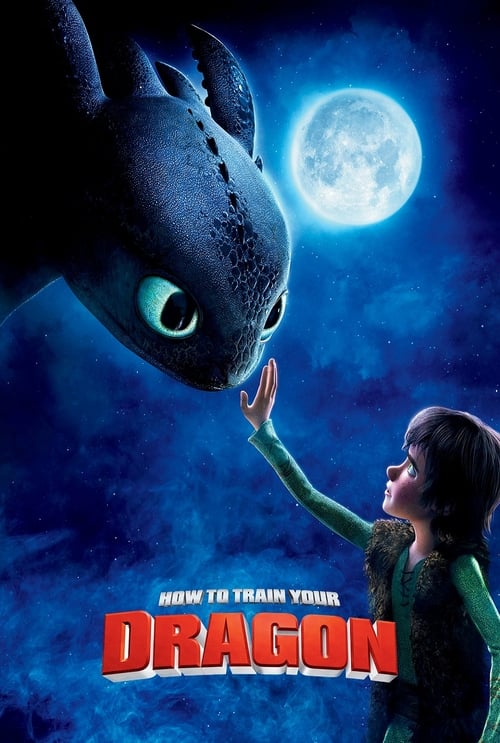
How to Train Your Dragon (2010)
Directed by Dean DeBlois
No · Ultra Based
How we score movies →Consciousness Markers
America Ferrera provides female representation as Astrid, but the ensemble is predominantly white and male-dominated, with limited diversity in voice casting or character prominence.
Astrid is a capable female warrior, but her role remains secondary to Hiccup's protagonist arc, and no explicit feminist messaging emerges from the narrative.
Hiccup is portrayed as socially awkward and physically different from his peers, but the film does not explicitly engage with neurodivergence as a modern social category.
Set in a fictional Viking fantasy realm with no meaningful engagement with racial representation or consciousness as a thematic concern.
The film conveys its themes through character development and narrative action rather than expository dialogue or preachy preaching.
No LGBTQ+ themes, representation, or subtext present in the film's narrative or character relationships.
No climate change messaging or environmental crusade elements appear in the film's story or worldbuilding.
No critique of capitalism, wealth inequality, or economic systems present in the narrative.
No body positivity messaging or commentary on body image standards is evident in the film.
As a fantasy narrative, the film does not engage in historical revisionism of real-world events.


Synopsis
As the son of a Viking leader on the cusp of manhood, shy Hiccup Horrendous Haddock III faces a rite of passage: he must kill a dragon to prove his warrior mettle. But after downing a feared dragon, he realizes that he no longer wants to destroy it, and instead befriends the beast – which he names Toothless – much to the chagrin of his warrior father.
Why it received this score
How to Train Your Dragon arrived in 2010, during that quaint period when animated films could simply tell stories about friendship and self-acceptance without conducting a comprehensive audit of their social positioning. The film concerns itself with Hiccup's rejection of his father's martial expectations, a narrative that resonates with themes of individualism and nonconformity, but these emerge as character beats rather than cultural statements. We are watching a young man find his own path, not a meditation on systemic oppression or progressive identity politics.
The film's approach to its protagonist deserves careful consideration. Hiccup is physically slight, socially clumsy, and intellectually oriented in a society that values strength and combat prowess. His arc involves proving his worth through means that do not conform to warrior-culture expectations. This is genuinely subversive for a 2010 children's film, but the subversion operates on the level of individual character agency and personal growth, not on the level of explicit social consciousness. The film does not announce its themes or pause to explain why nonconformity matters. It simply shows us a boy who finds peace with himself through compassion rather than violence.
The casting reflects the film's pre-woke sensibilities. Gerard Butler's Stoick is a gruff Viking father, Jay Baruchel's Hiccup is the nervous protagonist, and the supporting cast includes comedians like Jonah Hill and Craig Ferguson. America Ferrera's Astrid is a capable warrior, but she functions primarily as a romantic interest and secondary character. The film makes no particular statement about gender representation or racial diversity. It is what it is: a mid-budget DreamWorks animated feature that happens to contain some progressive character dynamics without feeling obligated to foreground them as such. One might call this innocent, though "innocent" in retrospect always carries a certain irony.
Analysis generated by our Consciousness Algorithm
Critic Reviews
“Rouses you in conventional ways, but it's also the rare animated film that uses 3-D for its breathtaking spatial and emotional possibilities.”
“There's much more to the adventure, a deft balance of fantasy and teen angst that never loses its contemporary sense of humor.”
“An exciting, fun and sensationally entertaining movie for everyone.”
“You could say the 3-D animated kidpic How To Train Your Dragon is "Avatar" for simpletons. But that title is already taken, by "Avatar."”