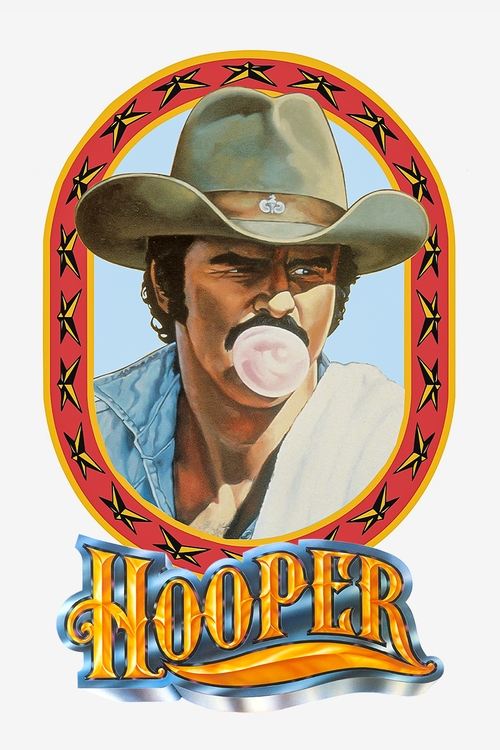
Hooper (1978)
Directed by Hal Needham
No · Ultra Based
How we score movies →Consciousness Markers
Sally Field appears in a significant supporting role as a love interest, which was notable for 1978, but the film remains male-centered with all major action sequences dominated by male performers.
While the film acknowledges stuntwomen exist and deserve recognition, it does not engage with feminist critique or consciousness. The narrative centers entirely on male achievement.
While the protagonist struggles with pain and addiction issues, these are treated as physical consequences of dangerous work rather than neurodivergent representation or advocacy.
No LGBTQ+ themes, representation, or subtext present in the film.
The film contains no racial consciousness, commentary on race, or deliberate diversification of cast. It reflects the 1970s Hollywood default.
No climate-related themes or environmental consciousness present.
The film celebrates capitalist success and individual achievement within the Hollywood system without critique.
No body positivity themes or commentary. The narrative focuses on physical prowess and masculine capability.
The film contains no revisionist historical claims or reinterpretation of historical events.
No preachy moralizing or lecture-like delivery of social messages. The film simply tells its story of stuntwork.


Synopsis
Legendary stunt man Sonny Hooper remains one of the top men in his field, but due to too many stressful impacts to the spine and the need to pop painkillers several times a day, he knows he should get out of the industry before he ends up permanently disabled.
Why it received this score
Hooper stands as a curious artifact from the pre-woke epoch, a time when cinema could celebrate masculine achievement without footnotes or apologies. Directed by Hal Needham, a stunt coordinator who understood his subject with the intimacy of a craftsman, the film operates as a love letter to an underappreciated profession. Burt Reynolds embodies Sonny Hooper with the effortless charm that defined his 1970s dominance, a man confronting the physical consequences of a lifetime spent crashing through windows and falling off buildings. The narrative asks nothing of its audience except to admire the spectacle and the dedication required to execute it.
Sally Field's presence registers as progressive for 1978, yet she remains subordinate to the male-centered action. The film's acknowledgment that stuntwomen exist and deserve recognition never translates into actual progressive sensibility, merely into a passing tribute. There is no interrogation of gender, no examination of systemic inequality, no meta-commentary on representation. These simply were not the concerns of Hollywood action cinema in 1978.
The cultural irrelevance of modern progressive markers to this film is almost complete. Hooper is about professional pride, physical pain, and the pursuit of one perfect stunt. It inhabits a world where such concerns dominate entirely, where identity politics have not yet colonized the narrative space. This is not a virtue or a failing, merely a historical fact. We are evaluating a film from a different cultural era by the standards of our own, which is why the score remains so decisively low.
Analysis generated by our Consciousness Algorithm
Critic Reviews
“Hooper has all the action that fans of this genre could ask for, plus a whole lot more.”
“This time, Mr. Reynolds has made a movie to please fans of all persuasions, and to please them a great deal.”
“Individually, the performances in this story of three generations of Hollywood stuntmen are a delight. And Hal Needham’s direction and stunt staging are wonderfully crafted.”
“Another mindless exercise in unexciting, unmotivated action sequences punctuated by moments of stupid, redneck, good-ol'-boy humor.”