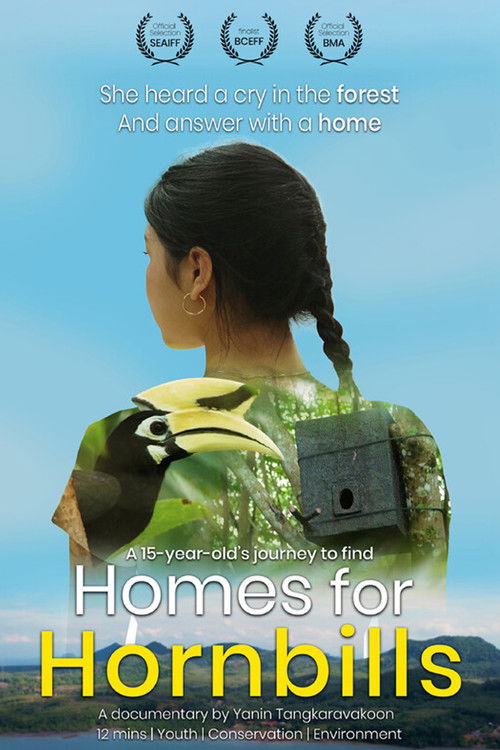
Homes for Hornbills (2025)
Directed by Yanin Tangkaravakoon
No · Based
How we score movies →Consciousness Markers
Climate consciousness is the film's central concern, with deforestation and ecosystem collapse driving the narrative. The artificial nest solution represents climate-aware innovation, though the approach remains pragmatic rather than ideologically radical.
The protagonist is a young Thai woman leading conservation work in her own community, providing some representation value. However, the film makes no explicit point of this identity, presenting it simply as circumstance rather than as a conscious statement about female leadership.
A young woman is the central figure and filmmaker, which naturally positions femininity as capable and innovative. However, the film contains no explicit feminist messaging or commentary on gender dynamics.
The film is set in Thailand and features Thai communities working on conservation. There is no explicit racial or postcolonial framing, and the work is presented as universal conservation practice rather than as addressing any specific racialized injustice.
The documentary maintains a straightforward, observational tone with minimal narration. The filmmaker presents her work without sermonizing, allowing the project itself to speak rather than lecturing the audience about environmental urgency.
The solution explicitly involves access to a private family polymer lab and corporate partnership, representing a capitalist approach to environmental problem-solving. There is no critique of economic systems or class structures.
No LGBTQ+ themes or representation appear in this environmental documentary.
Body positivity has no relevance to this wildlife documentary.
Neurodivergence is not addressed in this film.
The film contains no historical content and therefore no revisionist historical framing.
Synopsis
Hornbills, known as "farmers of the forest", are vital in dispersing seeds and regenerating ecosystems. Due to deforestation, Thailand's forests are vanishing, and hornbills are losing the ancient trees they depend on to nest. When Yanin first hears a hornbill's call, it becomes a call to action. With access to her family's polymer lab and support from Thailand's Hornbill Research Foundation, she helps develop a new artificial nest, which was then installed on Yao Noi Island, where nesting is in crisis.
Why it received this score
Homes for Hornbills presents a curious case study in the modern documentary landscape. At twelve minutes, it follows 15-year-old filmmaker Yanin Tangkaravakoon as she documents her own conservation initiative, resulting in a work that is earnest, technically competent, and fundamentally apolitical in its approach to environmental crisis. The film concerns itself with a concrete problem (deforestation threatening hornbill nesting sites) and a concrete solution (polymer-based artificial nests developed through her family's lab). One observes no sermonizing, no vilification of capitalism, no extended meditations on systemic injustice. This is problem-solving cinema, the work of someone who saw a thing that needed fixing and fixed it.
The film's relationship to contemporary progressive sensibilities is oblique and muted. Its climate consciousness is genuine but not performative. The environmental degradation depicted is presented as a matter of ecological necessity rather than as an indictment of Western consumption patterns or industrial civilization writ large. There is no lecture energy whatsoever. The documentary simply shows hornbills, shows trees disappearing, shows the artificial nests being installed, and narrates the process with straightforward efficiency. The protagonist is a young woman from Thailand working within her own community, which provides some representation value, though the film makes no point of this fact.
What unfolds instead is a work that prioritizes efficacy over ideology. The artificial nests represent a pragmatic accommodation with the existing order of things, not a revolution against it. This restraint, while admirable from a filmmaking perspective, places Homes for Hornbills firmly in the lower-middle range of cultural consciousness scoring. It is environmentally conscious without being ideologically charged, diverse without being performative, and earnest without being preachy. For those accustomed to the full rhetorical arsenal of contemporary progressive cinema, the film may seem almost conservative in its refusal to expand its scope beyond the immediate problem at hand.
Analysis generated by our Consciousness Algorithm