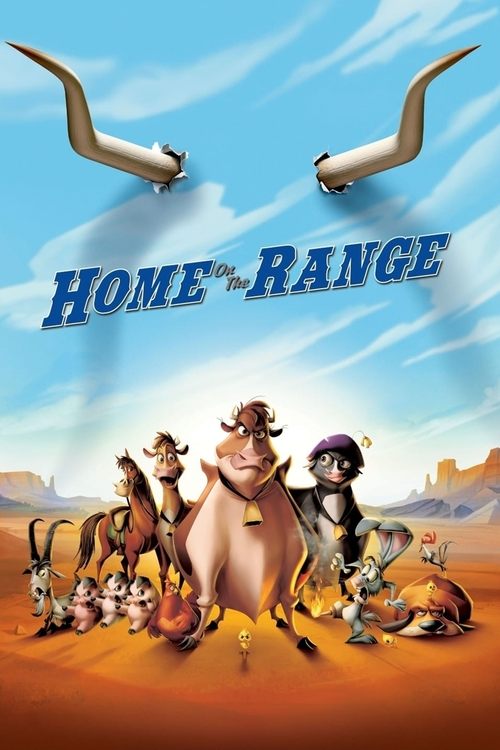
Home on the Range (2004)
Directed by Will Finn
No · Based
How we score movies →Consciousness Markers
The villain is a greedy capitalist outlaw attempting to seize property through fraud. However, the anti-capitalist framing is conventional rather than ideological.
Three female cattle serve as protagonists, and the supporting cast includes Cuba Gooding Jr. as a male character. However, this reflects the story's needs rather than a deliberate representation framework.
Female protagonists take action and demonstrate agency, but the feminism is incidental to the plot. The film does not engage with feminist ideology or consciousness.
The cast includes actors of color, but there is no explicit engagement with racial themes or consciousness. Diversity appears present without commentary.
The film presents its themes through straightforward storytelling without preachy lectures or heavy-handed social messaging.
The film uses the Western genre as backdrop but does not engage in revisionist historical commentary about colonialism, indigenous peoples, or other historical injustices.
No LGBTQ+ themes, representation, or subtext are present in this film.
No climate-related themes or messaging appear in this film.
Body positivity discourse is entirely absent from this 2004 family film.
No representation of or engagement with neurodivergence appears in the narrative.


Synopsis
When a greedy outlaw schemes to take possession of the "Patch Of Heaven" dairy farm, three determined cows, a karate-kicking stallion and a colorful corral of critters join forces to save their home. The stakes are sky-high as this unlikely animal alliance risk their hides and match wits with a mysterious band of bad guys.
Why it received this score
Home on the Range presents itself as a cheerful anachronism, a film that happened to include female protagonists and a diverse cast during an era when Disney was not yet obligated to do so by contemporary cultural pressures. The three cows (Maggie, Mrs. Calloway, and Grace) drive the narrative forward through their own determination and wit, and they are surrounded by a supporting cast that includes performers of color, yet none of this carries the weight of conscious representation. It is simply the film that was made.
The story's anti-capitalist undercurrent, wherein the villain Alameda Slim embodies greed and property theft, offers mild critique of wealth accumulation, though this reads as standard narrative conflict rather than ideological positioning. The film concerns itself with collective action and solidarity, themes that align with progressive sensibilities, but these emerge from the adventure plot rather than from any systematic engagement with social consciousness.
What we have, ultimately, is a 2004 family film that predates the contemporary cultural moment by more than a decade. Its female leads and diverse casting are genuine, if unremarkable by modern standards. The film's modest score reflects not a deficiency but a simple temporal fact: it was made before the frameworks we now use to analyze such things became culturally dominant. It remains a curiosity from an earlier era of animation, when such choices required no explanation or justification beyond narrative logic.
Analysis generated by our Consciousness Algorithm
Critic Reviews
“A sweet, raucously funny, comic Western that corrects a glaring historical injustice by finally surveying the Old West through the eyes of cows rather than cowboys. ”
“Has a wacky charm and a feeling like no other Disney film in recent years. ”
“Old-style animation slows down after a snappy start, but it's lively enough to keep kids from fidgeting too much. ”