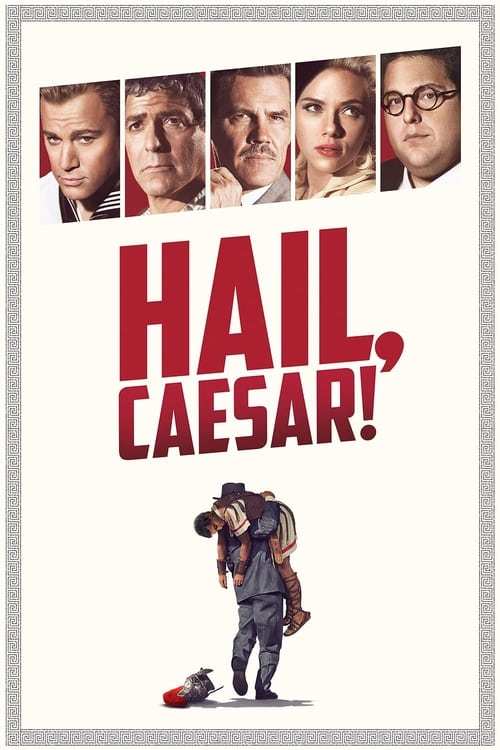
Hail, Caesar! (2016)
Directed by Joel Coen
No · Based
How we score movies →Consciousness Markers
The film satirizes Hollywood capitalism through its studio system plot and briefly engages with communist ideology, though primarily as comedic material rather than serious critique.
Channing Tatum's character features coded homoerotic subtext in a musical number, suggesting implicit queerness that remains ambiguous rather than explicit.
Scarlett Johansson plays a starlet portrayed primarily as a comedic object of desire without meaningful agency or character development.
The film faced direct criticism upon release for its overwhelmingly white cast and minimal meaningful roles for actors of color, despite the historical setting not requiring such choices.
The film presents an idealized, nostalgic view of 1950s Hollywood that avoids interrogating the era's actual racism, sexism, and systematic exclusions.
While thematically layered, the film prioritizes comedy and absurdist satire over preachy messaging, allowing its humor to carry thematic weight rather than explicit instruction.
The film contains no engagement with race, racial history, or racial representation despite its Hollywood setting and 2016 release date.
No climate-related themes, imagery, or messaging appear in the film.
No body positivity messaging, representation, or thematic content appears in the film.
No neurodivergent representation or thematic engagement is present in the film.


Synopsis
When a Hollywood star mysteriously disappears in the middle of filming, the studio sends their fixer to get him back.
Why it received this score
The Coen Brothers' 1950s Hollywood fable arrives as a curious historical artifact of 2016 progressive cinema, which is to say it demonstrates precisely why critics began asking uncomfortable questions about the brotherhood's imaginative horizons. When the film premiered, commentators immediately noted the pervasive whiteness of both principal cast and background players, prompting the Coens to defend their choices with the measured indifference of artists who had not considered the question worth asking in the first place. The studio system satire proceeds as a kind of theological comedy, with Hollywood capitalism, Catholic faith, and Soviet communism competing for spiritual dominance in the lives of its characters. None of these ideologies receives serious interrogation. The film's treatment of communism, filtered through a Soviet kidnapping plot, functions purely as comedic fodder rather than as an opportunity for actual ideological engagement.
The film romanticizes 1950s Hollywood while studiously avoiding the era's actual racism, sexism, and systematic exclusions. Scarlett Johansson's starlet exists primarily to be ogled and dismissed. The cast of thousands working in background positions contains virtually no faces of color, a choice that speaks volumes about the filmmakers' assumptions regarding historical authenticity and dramatic necessity. The single moment of queerness, a musical number featuring Channing Tatum, registers as campy subtext rather than genuine representation.
The film's humor remains clever and its production design immaculate, but these merits operate entirely within a narrow bandwidth of cultural consciousness. The Coens have constructed a world in which the only ideologies worth satirizing are those that pose no threat to the film's own comfortable perspective. This is satire as a form of insulation rather than interrogation, a way of appearing to critique power while ensuring that certain hierarchies remain undisturbed.
Analysis generated by our Consciousness Algorithm
Critic Reviews
“Hail, Caesar! is a brilliant satire depicting a bygone era of filmmaking that we'll never see again.”
“The Coen's prowessness for balance is also important to note here, as it's never overtly satirical and the balance of recognizing the chaos but also giving us grounded humanity results in the film being playful.”
“In other words, it's perfect, and like the best of the duo's achievements it's an ending I'm going to be pondering for quite a long time to come.”
“Hail, Caesar! imagines the inner dealings of Hollywood during the early 20th century but the film's point for these shenanigans is possibly nonexistent.”