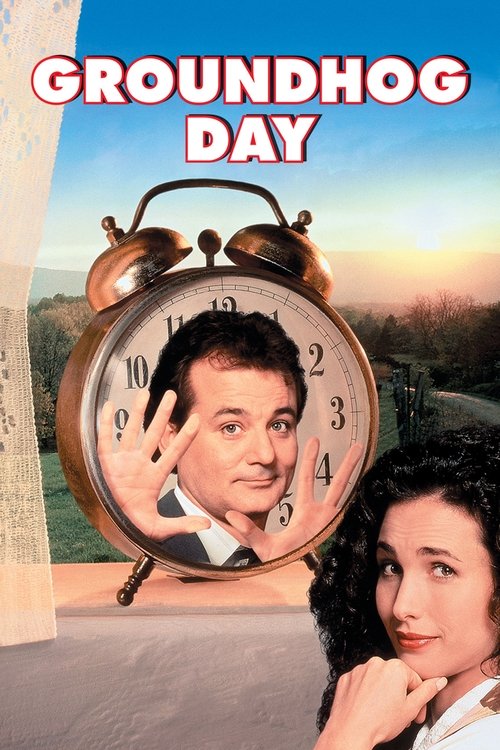
Groundhog Day (1993)
Directed by Harold Ramis
No · Ultra Based
How we score movies →Consciousness Markers
Rita is competent and intelligent, but functions primarily as a romantic prize to be won through Phil's self-improvement, reflecting 1990s rather than contemporary feminist sensibilities.
The cast reflects 1993 mainstream Hollywood demographics with no apparent attention to diversity or representation as a conscious value.
No LGBTQ+ characters or themes appear in the film. The narrative centers entirely on heterosexual romance.
Race is never addressed, discussed, or thematized. The film contains no racial consciousness or commentary.
Climate and environmental themes do not appear in the narrative, despite the film's setting and weather-reporting premise.
The film contains no critique of capitalism or wealth inequality. Phil works within the media establishment without ideological conflict.
Body diversity and body positivity are not thematized. The film reflects conventional 1990s beauty standards without comment.
No neurodivergent characters or themes appear. Mental health is not addressed through a contemporary framework.
The film contains no historical revisionism or reinterpretation of past events through contemporary lenses.
The film never pauses to lecture the audience about social issues or correct contemporary attitudes. Its tone remains consistently comic and philosophical.


Synopsis
A cynical TV weatherman, along with his idealistic producer and his sardonic cameraman, is sent to report on Groundhog Day in the small town of Punxsutawney, where he finds himself repeating the same day over and over.
Why it received this score
Groundhog Day exists in a peculiar temporal pocket, a 1993 film so thoroughly committed to its own metaphysical concerns that it remains almost entirely unmolested by the cultural anxieties of any era. Bill Murray's Phil Connors undergoes a redemption arc driven by spiritual growth and romantic love, not by consciousness-raising or structural critique. The film operates according to the logic of personal transformation through suffering, a narrative mode that predates contemporary social awareness by centuries.
The female lead, Rita Hanson, occupies the role of the idealistic love interest who gradually softens the protagonist's misanthropy. She is competent, intelligent, and serves as the moral compass of the narrative. Yet her characterization reflects 1993 sensibilities, not 2020s progressive sensibilities. She exists as a romantic object to be won through Phil's self-improvement, and the film harbors no anxiety about this arrangement. There is no interrogation of power dynamics, no discussion of consent beyond the obvious, and no suggestion that the premise itself contains troubling elements. The camera does not linger on her body in a way meant to challenge beauty standards. She is simply a woman in a movie about a man's redemption.
The film's comedy derives from absurdist repetition and character observation, not from identity politics or social commentary. It contains no characters explicitly coded as marginalized, no moments designed to signal contemporary progressive values, and no lecture energy whatsoever. What remains is a masterfully constructed comedy of manners, proof that a film need not engage with modern cultural preoccupations to achieve excellence. Groundhog Day is innocent of wokeness not through malice but through temporal distance.
Analysis generated by our Consciousness Algorithm
Critic Reviews
“For once, the audience isn't forced to surrender its intelligence (or its healthy cynicism) to embrace the film's sunny resolution.”
“This movie has all the qualities necessary to be a crowd-pleaser: likable characters, charismatic performers, a strong, capably-executed premise, and lots of laughs.”
“With its zany daily episodes, "Groundhog" gets stuck in a non-progressive repetition.”