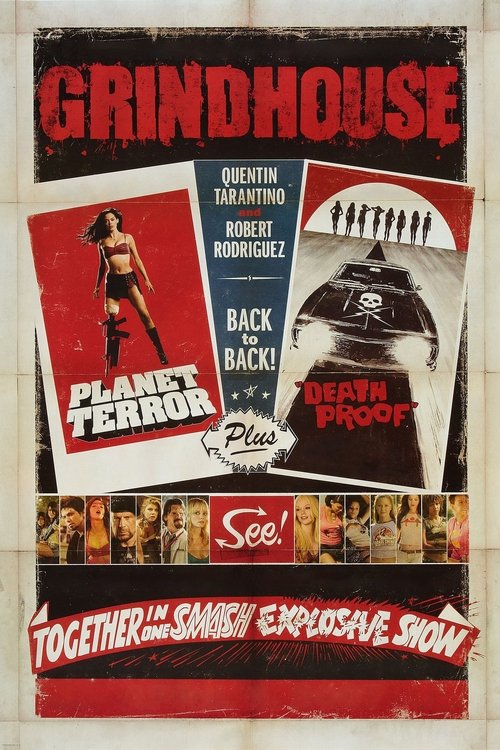
Grindhouse (2007)
Directed by Quentin Tarantino, Robert Rodriguez
No · Ultra Based
How we score movies →Consciousness Markers
Death Proof provides female characters with violent agency and revenge against a serial killer, but within an exploitation genre context that fetishizes female bodies and violence rather than advancing feminist consciousness.
Diverse casting includes women and actors of color, but they function primarily as victims and action figures within an exploitation framework rather than reflecting conscious representation initiatives.
The film is primarily concerned with style, spectacle, and genre pastiche rather than preachy messaging, though its meta-commentary on exploitation cinema carries minimal reflective energy.
No LGBTQ+ themes, characters, or representation present in the film.
The film contains no racial commentary, consciousness, or interrogation of racial dynamics. It is a genre pastiche unconcerned with such themes.
No climate themes, messaging, or environmental consciousness present.
No anti-capitalist messaging or critique of economic systems.
The film presents conventionally attractive bodies within an exploitation framework designed to maximize visual spectacle and sexual display. No body positivity messaging.
No representation of or thematic engagement with neurodivergence.
While functioning as a homage to past cinema, the film does not revise or reinterpret historical narratives.


Synopsis
Grindhouse combines Robert Rodriguez's Planet Terror, a horror comedy about a group of survivors who battle zombie-like creatures, and Quentin Tarantino's Death Proof, an action thriller about a murderous stuntman who kills young women with modified vehicles. It is presented as a double feature with fictitious exploitation trailers preceding each segment.
Why it received this score
Grindhouse stands as a deliberately retrograde artifact, a lovingly crafted homage to the exploitation cinema of the 1960s and 70s that makes no pretense of contemporary social consciousness. Rodriguez and Tarantino have constructed a film that wallows in the aesthetic pleasures of low-budget transgression, complete with fake trailers and intentional print damage, all in service of a double feature that celebrates excess, gore, and female bodies as sites of violence and spectacle. The film is unapologetically unconcerned with progressive sensibilities.
Death Proof's conclusion does grant its female characters a moment of violent agency and revenge against their predator, but this operates squarely within the revenge fantasy tradition rather than any coherent statement about gender or power. The women achieve victory through brutality, not through consciousness-raising or systemic critique. Similarly, Planet Terror treats its cast of characters as expendable vessels for Rodriguez's visual pyrotechnics and practical effects wizardry. The ensemble, which includes actresses of color, serves the narrative demands of zombie carnage rather than any deliberate representation framework.
The film's cultural position is that of calculated nostalgia for a disreputable past. It asks us to enjoy the pleasures of exploitation cinema precisely as exploitation cinema, which places it at considerable distance from the values of modern progressive sensibilities. This is not a film that wrestles with its own transgressiveness or seeks to interrogate the power dynamics embedded in its source material. It is, instead, a film that celebrates them.
Analysis generated by our Consciousness Algorithm
Critic Reviews
“This monumentally pointless movie is best summarized by a line from Planet Terror: "At some point in your life, you find a use for every useless talent you have." Rodriguez, Tarantino, and Co. aim for nothing more noble than to freak the funk, and it's about godd--- time. Go wasted, go stoned, go without your parents' permission. In paying homage to an obsolete form of movie culture, Grindhouse delivers a dropkick to ours.”
“Grindhouse, like "Ed Wood" and "Boogie Nights," celebrates how certain low-grade entertainment, viewed in hindsight, looks different now than it did then, since we can see the ''innocence'' of its creation -- the handmade quality of it -- in a world not yet ruled by corporate technology.”
“I suspect that Death Proof will throw some of its director's admirers for a loop, though it may be the most revealing thing Tarantino has yet done -- a full-throttle expression of a singular artistic temperament disguised, like so many gems of grindhouses yore, as a glittering hunk of trash.”
“The mock trailers are for impossibly schlocky Z-movies with titles like "Machete," "Don't Scream," "Thanksgiving" and "Werewolf Women of the S.S." They're by far the funniest part of the program, possibly because they're mercifully brief.”