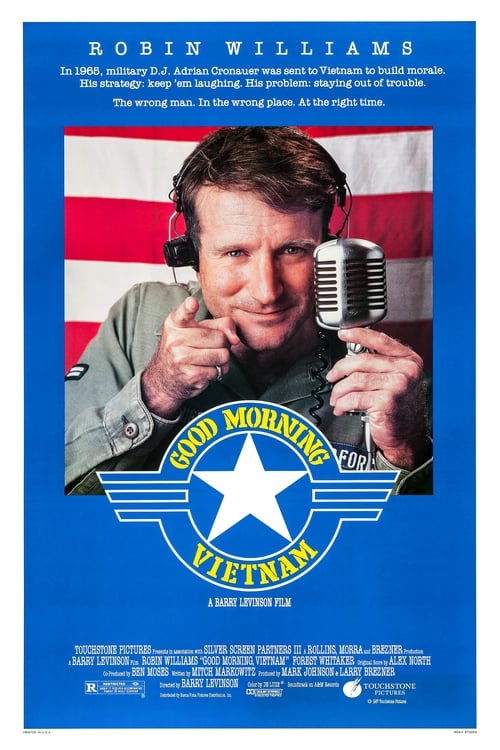
Good Morning, Vietnam (1987)
Directed by Barry Levinson
No · Ultra Based
How we score movies →Consciousness Markers
Forest Whitaker appears in a supporting role as a Black military officer, but Vietnamese and Asian characters remain marginalized and underdeveloped. Casting reflects 1980s Hollywood norms rather than any conscious effort toward diverse representation.
The film contains occasional moments of moral seriousness regarding the absurdity of war, but these are subordinate to comedic entertainment. There is no preachy impulse to educate the audience about systemic injustice.
While Forest Whitaker's character is portrayed with dignity, Vietnamese characters lack agency and perspective. The film centers American military experience and ignores Vietnamese civilian impact.
Vietnamese women appear as romantic interests and exotic objects. The film exhibits no feminist consciousness and treats female characters as accessories to male narrative arcs.
The film presents a simplified, Americentric view of the Vietnam War that elides Vietnamese perspective and suffering. This is not revisionist history per se but rather a profound absence of historical reckoning.
No LGBTQ+ themes, characters, or representation are present. The film's romantic subplot involves heterosexual relationships only.
Climate themes are entirely absent from the narrative. The film does not engage with environmental concerns.
No anti-capitalist themes are present. The film critiques military bureaucracy rather than economic systems.
Body positivity is not a concern of this film. No characters are presented with intentional body diversity or commentary on physical appearance.
Neurodivergence is not represented or explored. The film contains no characters or themes related to autism, ADHD, or other neurodivergent conditions.


Synopsis
A disk jockey goes to Vietnam to work for the Armed Forces Radio Service. While he becomes popular among the troops, his superiors disapprove of his humor.
Why it received this score
Good Morning, Vietnam remains a product of the late 1980s in ways that matter for contemporary analysis. The film presents the Vietnam War through the lens of American military personnel, centering the experiences and emotions of white servicemen while Vietnamese characters function primarily as background scenery or romantic interests. Robin Williams' portrayal of Adrian Cronauer, while comedically vibrant, ultimately reinforces the notion that American individual expression and personality trump institutional authority, a thoroughly liberal but distinctly pre-woke sensibility. The film's humor derives largely from cultural clash and the juxtaposition of American irreverence against bureaucratic rigidity, not from any interrogation of systemic power structures or the violence embedded in colonialism.
The supporting cast includes Forest Whitaker as Sergeant Major Phillip Phillip, whose role exists to provide sober military counterpoint to Cronauer's antics. This pairing, while not offensive, reflects a particular era of Hollywood casting where Black actors were positioned as moral anchors or authority figures in relation to white protagonists' charisma. Vietnamese characters, including Tom T. Tran and Chintara Sukapatana, are afforded minimal development and exist primarily within the romantic and exotic framework common to Vietnam War cinema of that period. There is no interrogation of Vietnamese agency, no representation of Vietnamese perspectives on the conflict, and no acknowledgment of civilian casualties or the war's devastating impact on the Vietnamese population. The film's progressive credentials consist entirely of its mockery of military hierarchy and its implicit critique of censorship, which reads as classically liberal rather than exhibiting any markers of modern progressive social consciousness.
The film's orientation remains American and military. Its project is entertainment and the celebration of individualism against institutional conformity, not the advancement of any particular social justice agenda. For a 1987 film, this is unsurprising and unremarkable. By contemporary standards, the absence of perspective from those most harmed by the conflict, the reductive portrayal of Vietnamese women, and the centering of American emotional experience constitute significant blind spots. Yet the film does not actively promote reactionary ideology or celebrate oppression. It simply inhabits an older framework entirely.
Analysis generated by our Consciousness Algorithm
Critic Reviews
“Good Morning, Vietnam works as straight comedy and as a Vietnam-era MASH, and even the movie’s love story has its own bittersweet integrity. ”
“One of Levinson's best films, and one of Hollywood's best films on the whole Vietnam subject.”
“Good Morning, Vietnam, directed by Barry Levinson (Diner, Tin Men) succeeds in doing something that's very rare in movies, being about a character who really is as funny as he's supposed to be to most of the people sharing the fiction with him. It's also a breakthrough for Mr. Williams, who, for the first time in movies, gets a chance to exercise his restless, full-frontal comic intelligence.”
“The way the story line has been directed it's a clumsier versions of the plots of 50s musicals.”