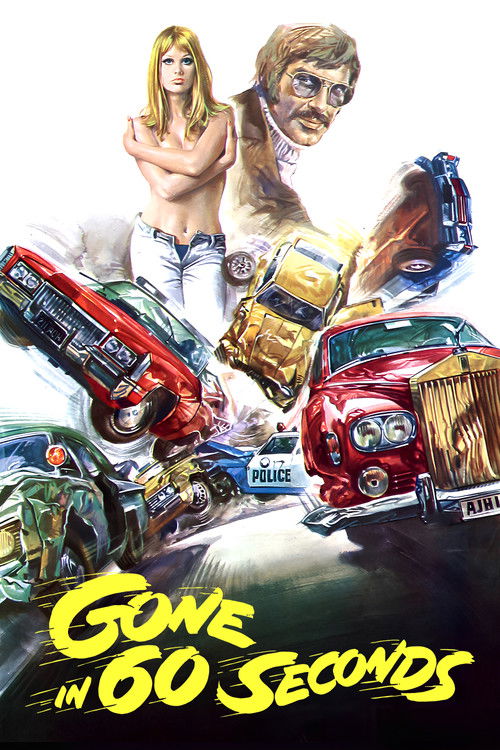
Gone in 60 Seconds (1974)
Directed by H.B. Halicki
No · Ultra Based
How we score movies →Consciousness Markers
Nearly all substantive roles are male. Marion Busia appears but in a marginal capacity. No deliberate commitment to diverse representation beyond the unconscious demographics of the era.
A South American drug lord serves as the villain, but this is treated as a generic crime thriller trope without nuanced cultural awareness or meaningful representation.
The film is male-centric. Women appear peripherally if at all, and there is no feminist messaging or interrogation of gender dynamics.
While crime occurs, it is motivated purely by mercenary profit, not political resistance or critique of capitalist systems. The criminals are entrepreneurs, not revolutionaries.
No LGBTQ+ characters, themes, or references of any kind. The film is entirely heteronormative and makes no acknowledgment of sexual or gender diversity.
Entirely absent. The film celebrates automotive theft and driving without any environmental consciousness or concern for ecological impact.
Not applicable to this action thriller. The film makes no commentary on body diversity or acceptance.
Neurodivergence is neither represented nor discussed. No characters with visible neurodivergent traits or any thematic engagement with the topic.
The film is not historical in nature and makes no attempt to reframe or reinterpret historical events.
Pure plot and action. The film contains no preachy messaging, social commentary, or lectures about any social issues whatsoever.


Synopsis
Insurance investigator Maindrian Pace and his team lead double-lives as unstoppable car thieves. When a South American drug lord pays Pace to steal 48 cars for him, all but one, a 1973 Ford Mustang, are in the bag. As Pace prepares to rip-off the fastback, codenamed "Eleanor", in Long Beach, he is unaware that his boss has tipped off the police after a business dispute.
Why it received this score
Gone in 60 Seconds is a 1974 action film so comprehensively indifferent to contemporary social consciousness that it reads as a document of pure unreflective capitalism. The narrative concerns itself solely with the mechanics of automotive theft and the logistics of crime for profit, treating its South American antagonist as a generic source of payment rather than engaging in any meaningful cultural representation. Halicki's film is a functional thriller, not a social statement, and makes no pretense otherwise.
The cast is overwhelmingly male, the perspective relentlessly focused on the mechanical and vehicular rather than the human and interpersonal. Women appear in the film largely as incidental figures, their presence neither interrogated nor celebrated. There is no engagement whatsoever with questions of representation, identity, or the systems that structure access to power and resources. The film celebrates speed, theft, and masculine competence without a trace of irony or critique.
What we have here is a work that predates contemporary cultural consciousness by several years, which is to say it operates in a register entirely prior to the frameworks we now use to evaluate such matters. This is not a failing in 1974 terms, merely an observation. The film exists in a universe where such considerations have not yet entered the popular imagination, and it makes no apologies for that fact. It remains precisely what it was intended to be: a showcase for car chases and stunts, nothing more.
Analysis generated by our Consciousness Algorithm
Critic Reviews
“You have to love a movie where a car gets title billing. [30 Nov 2000, p.F16]”
“A lot of cinematic ineptitude and moral turpitude can be forgiven in the final 40 minutes, when Halicki redeems his movie by staging one of the greatest car chase scenes in history -- one without much, if any, fakery. [01 Dec 2000, p.8E]”
“The wealth of sketched-in technical detail is fairly engrossing, and the energy of this Halicki production (he also wrote, directed, stars and supplied the vehicles) is arresting. It's a pity that it had to descend into such routine carnage.”
“Amateurish, badly acted and shot on the cheap (many sequences don't even have sync sound), this cult item features a 40-minute car chase (almost half the film's running time) that's nothing short of breathtaking, particularly in light of the obvious budgetary constraints. ”