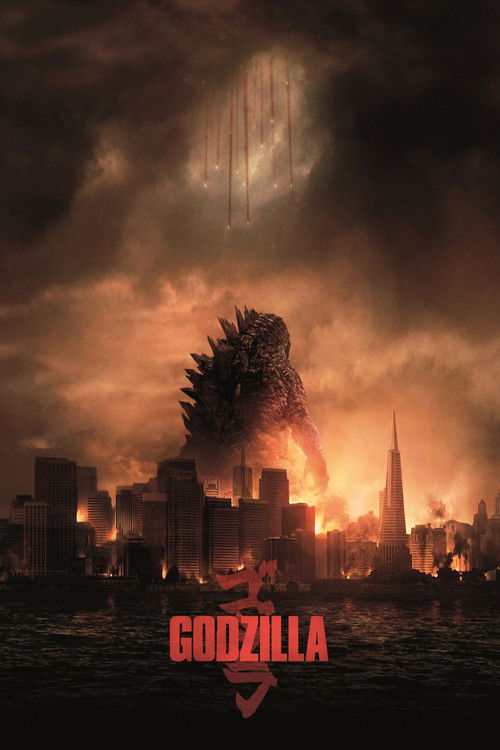
Godzilla (2014)
Directed by Gareth Edwards
No · Ultra Based
How we score movies →Consciousness Markers
Ken Watanabe appears in a supporting role, and the ensemble includes women, but without any foregrounding of diversity or celebration of representation. Inclusion exists functionally rather than intentionally.
Female characters occupy traditional supporting roles as wives and family members. Elizabeth Olsen's character exists primarily in relation to her husband's narrative arc.
No LGBTQ+ characters, themes, or representation present in the film.
No exploration of racial themes, systemic racism, or racial identity. The film treats its characters as generic disaster narrative participants.
While the film features natural disasters and environmental destruction, there is no advocacy for climate action or environmental consciousness. The focus is purely on spectacle.
No critique of capitalism, corporate power, or wealth inequality. The military-industrial response to the crisis is presented as necessary and unproblematic.
No representation of body diversity or body positivity messaging. The film does not engage with these themes.
No representation of neurodivergent characters or acknowledgment of neurodivergence.
The film reimagines the Godzilla mythology but does not revise historical narratives or reframe past events through a contemporary lens.
The film does not lecture audiences about social issues or attempt to educate viewers on matters of contemporary social consciousness.


Synopsis
Ford Brody, a Navy bomb expert, has just reunited with his family in San Francisco when he is forced to go to Japan to help his estranged father, Joe. Soon, both men are swept up in an escalating crisis when an ancient alpha predator arises from the sea to combat malevolent adversaries that threaten the survival of humanity. The creatures leave colossal destruction in their wake, as they make their way toward their final battleground: San Francisco.
Why it received this score
Gareth Edwards' 2014 reimagining of Godzilla is a film of almost aggressive cultural neutrality, a monument to the apolitical blockbuster at a moment when such things were still possible without comment. The narrative concerns itself exclusively with spectacle, family drama, and the logistics of destruction, treating its ensemble cast as functional units within a disaster apparatus rather than as vehicles for any particular social consciousness. Ken Watanabe appears in a supporting role, Sally Hawkins and Juliette Binoche populate the margins of the frame, and Elizabeth Olsen serves primarily as the anxious wife awaiting her husband's return from danger. These are not casting choices made in service of any progressive sensibility, but rather the normal functionality of a major studio production.
The film's thematic substrate, such as it exists, concerns the hubris of human scientific endeavor and the indifference of nature to our machinations. This is presented as a matter of physical spectacle rather than social critique. There is no interrogation of power structures, no meditation on systemic injustice, no suggestion that we might examine our relationship to environmental degradation or corporate malfeasance. The monsters destroy cities, the military responds, and we are asked to admire the scale of the destruction. This is pre-woke cinema in the truest sense, not because it is reactionary, but because it has not yet internalized the frameworks of contemporary social criticism as a necessary element of mainstream entertainment.
What we have here is a film that operates within the safety of pure spectacle, asking nothing of its audience except that they remain seated for two hours and accept the premise that large creatures will collide with buildings. It is, in this respect, a kind of aesthetic conservatism, a refusal to engage with the cultural conversations of its moment. For the contemporary critic trained to detect every subtle inflection of social consciousness in the films we consume, this is either a relief or a disappointment, depending on one's disposition.
Analysis generated by our Consciousness Algorithm
Critic Reviews
“Not that Honda's original Godzilla is a message movie first and foremost. It's a horror flick, and an ingenious one at that, with visual effects so vivid that gimmicky spin-offs became an enduring staple of popular film. ”
“The original retains its dark tone and deadly serious anti-war message. For today's moviegoing audiences, this may not be your daddy's Godzilla movie, but chances are your granddaddy could teach you a thing or two about the context. ”
“Godzilla is still the most awesome of tacky movie monsters.”
“Regaled for 50 years by the stupendous idiocy of the American version of Godzilla, audiences can now see the original Japanese version, which is equally idiotic.”