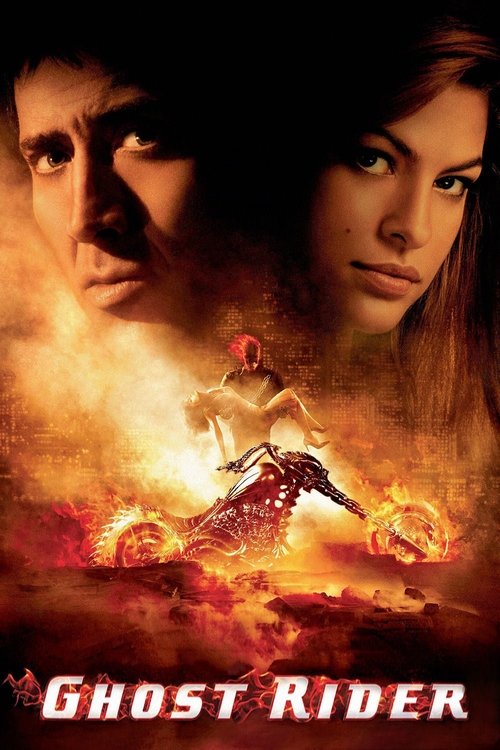
Ghost Rider (2007)
Directed by Mark Steven Johnson
No · Ultra Based
How we score movies →Consciousness Markers
The cast is predominantly white with minimal representation of non-white actors in significant roles. No deliberate effort toward inclusive casting is evident.
Eva Mendes' character Roxanne is nominally a reporter with professional agency, but functions primarily as a romantic motivation for the male protagonist. No meaningful feminist critique or progressive gender dynamics.
No LGBTQ+ themes, characters, or content appear in the film.
The film contains no racial themes, commentary, or consciousness. Race is not addressed as a thematic element.
No climate-related themes or environmental messaging appear in the film.
The film contains no critique of capitalism or economic systems. The plot concerns supernatural mythology, not economic structures.
No body positivity themes or messages are present. The film operates according to conventional action cinema aesthetics.
No neurodivergent characters or representation of neurodivergence appears in the film.
The film contains no historical elements or revisionist historical framing. It exists in a timeless supernatural space.
The film makes no attempt to educate, persuade, or lecture the audience on social or political matters.


Synopsis
In order to save his dying father, young stunt cyclist Johnny Blaze sells his soul to Mephistopheles and sadly parts from the pure-hearted Roxanne Simpson, the love of his life. Years later, Johnny's path crosses again with Roxanne, now a go-getting reporter, and also with Mephistopheles, who offers to release Johnny's soul if Johnny becomes the fabled, fiery 'Ghost Rider'.
Why it received this score
Ghost Rider stands as a monument to the pre-social consciousness era of superhero cinema, a film so thoroughly divorced from contemporary cultural sensibilities that it achieves a kind of archaeological purity. Nicolas Cage's Johnny Blaze pursues his supernatural vendetta with the emotional depth of a man possessed, which he is, and the supporting cast moves through the narrative with the kind of functional characterization that suggests they too understand this is a vehicle for fiery motorcycle stunts rather than meaningful human interaction. Eva Mendes performs the role of the love interest with the commitment of an actor who understands her primary function is to motivate the protagonist's arc, not to possess one of her own.
The film's construction reveals the casual indifference to representation that characterized mid-2000s action cinema. The cast is predominantly white, the gender dynamics are traditional, and the only acknowledgment of anything resembling social complexity comes from the film's supernatural mythology rather than its human relationships. There is no lecture, no message, no attempt to educate or persuade. This is not a film that believes it has anything to teach about society or the human condition beyond the mechanics of vengeance and redemption through demonic contract.
Mark Steven Johnson's direction prioritizes spectacle and plot machinery over character development or thematic depth. The film exists in a purely fantastical space where real-world social structures do not apply and therefore need not be interrogated. This is, in its own way, refreshing, though not for reasons that would satisfy contemporary critics concerned with cultural representation. Ghost Rider is what it is: a 2007 superhero film untouched by the progressive sensibilities that would come to dominate studio thinking in subsequent decades.
Analysis generated by our Consciousness Algorithm
Critic Reviews
“This time out, writer and director Mark Steven Johnson has bounced back with a movie so full of camp spirit it should come with tents and a marshmallow roast.”
“As a film on its own, Ghost Rider isn't amazing, but it is definitely a decent popcorn flick. As an entry into the superhero genre, Ghost Rider is only a couple notches above the "X-Men: The Last Stand."”
“A blockbuster that offers enough quirky pleasures to feel fresh and unpredictable.”
“Though the superhero's fans have long awaited his close-up, the Devil's bounty hunter -- complete with a burning skull for a head and a killer motorcycle in flames --materializes in a movie that never measures up to his infernal potential.”