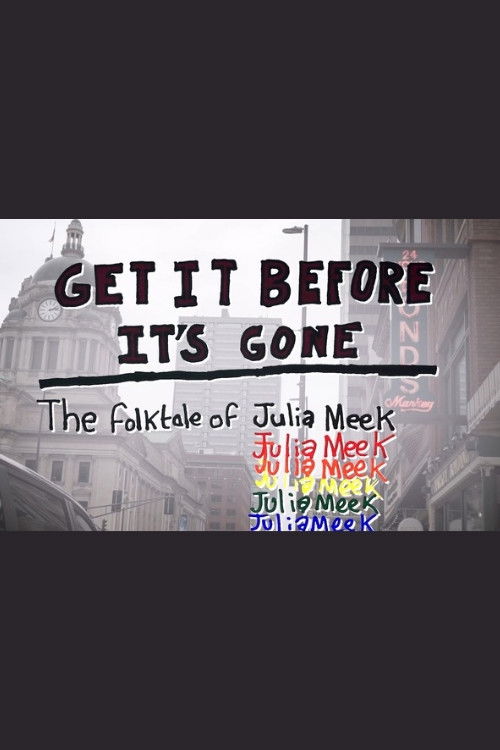
Get It Before It's Gone (2026)
Directed by Robert Tuori Greene
No · Ultra Based
How we score movies →Consciousness Markers
The film's focus on public radio and local arts institutions could be read as implicitly valuing non-commercial cultural work, though this appears incidental rather than ideological.
While Meek is a woman whose professional accomplishments are documented, the film does not appear to frame her story through feminist analytical lenses or contemporary gender politics.
As a short biographical documentary, the film likely contains some expository material, though nothing suggests hectoring or preachy intent.
The documentary features Julia Meek and her associates in a straightforward biographical context. No casting choices appear motivated by diversity considerations.
No LGBTQ+ themes or characters are evident in the available information about this local arts documentary.
The documentary presents Meek's work in arts advocacy without apparent engagement with racial or ethnic political frameworks.
Climate themes are entirely absent from this biographical work about a radio personality and arts advocate.
No body-related messaging or body positivity rhetoric appears in this documentary about a radio personality.
Neurodiversity themes are not present in the available material about this film.
The documentary appears to document Meek's actual career and contributions without reframing historical narratives.
Synopsis
A short documentary focusing on the life, work, and philosophy of Fort Wayne public radio personality Julia Meek.
Why it received this score
This short documentary functions as a straightforward portrait of Julia Meek, a Fort Wayne public radio figure whose career has centered on local arts advocacy and music curation. The film presents her life and philosophy without apparent ideological scaffolding, operating instead in the register of regional cultural documentation. There is nothing here to suggest this work was designed with the contemporary social consciousness apparatus in mind.
The production values appear modest, befitting its subject and scope. The film documents Meek's genuine contributions to her community through decades of radio work, which is precisely the kind of local institution-building that exists outside most frameworks of cultural analysis. Her passion for music, storytelling, and regional arts is presented as self-evident rather than as a vehicle for particular political positions. One observes the artifact of a person doing work she believes in, captured by someone who knows her.
There are no markers of contemporary progressive sensibility here worth cataloging. The film simply appears to be a memorial to a working life in public media, made with affection by a filmmaker who respects his subject. This is neither a deficiency nor a virtue from our analytical perspective. It is merely a film that exists outside the entire apparatus we are tasked with measuring.
Analysis generated by our Consciousness Algorithm