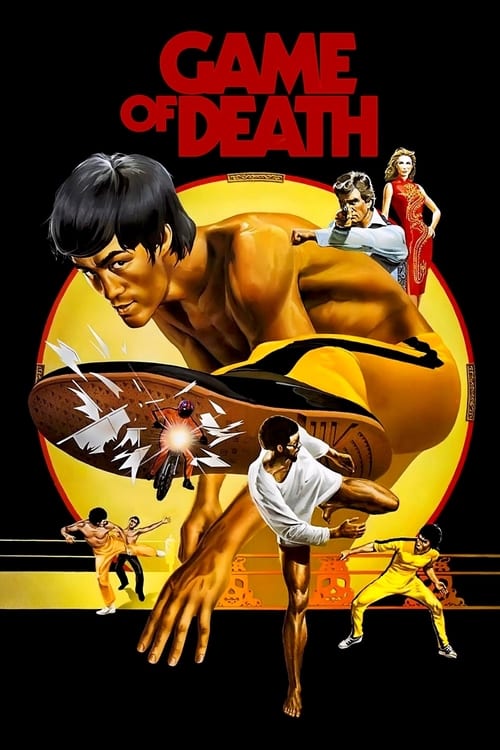
Game of Death (1978)
Directed by Robert Clouse
No · Ultra Based
How we score movies →Consciousness Markers
Bruce Lee's starring role as an Asian-American martial artist was itself groundbreaking in 1978, though the film contains no deliberate representation agenda. The supporting cast is otherwise unremarkable in terms of diversity.
While Bruce Lee's presence carries historical significance regarding Asian representation in action cinema, the film itself contains no explicit racial commentary or consciousness of systemic issues.
Colleen Camp has a minor role as a female character, but the film contains no feminist agenda or meaningful examination of gender dynamics.
No LGBTQ themes, characters, or subtext present in the film.
No climate-related themes, messaging, or environmental consciousness appears in this martial arts action film.
The film contains no critique of capitalism, wealth inequality, or systemic economic structures.
No body positivity messaging. The film celebrates martial arts physiques but contains no inclusive body representation or relevant commentary.
No representation of or engagement with neurodivergence in any form.
The film makes no attempt to reexamine historical narratives or challenge conventional historical understanding.
The film contains no preachy messaging, no speeches about social issues, and no sense of instructing the audience on political or cultural matters.


Synopsis
A martial arts movie star must fake his death to find the people who are trying to kill him.
Why it received this score
Game of Death stands as a curious artifact from 1978, a film that exists primarily as a vehicle for martial arts spectacle rather than social commentary of any stripe. Bruce Lee's presence, even fragmented by the use of body doubles for portions of the film, carries the cultural weight of a groundbreaking Asian-American action star who challenged Hollywood's racial hierarchies through sheer charisma and physical prowess. Yet the film itself remains resolutely apolitical, a revenge narrative stripped of any deeper thematic ambition. The cast includes Kareem Abdul-Jabbar and Chuck Norris as opponents in the film's tower sequences, suggesting that the production valued martial arts credentials over any consideration of representational equity or cultural messaging.
The film's relationship to progressive sensibilities is essentially null. There are no LGBTQ themes, no examination of systemic power structures, no climate consciousness, no revisionist historical impulses. Colleen Camp appears in a supporting role, but her presence registers as incidental rather than as any deliberate statement about gender or representation. The narrative concerns itself exclusively with physical combat, honor, and individual triumph against unnamed antagonists. Any progressive element that might be detected lies entirely outside the film's own ambitions, residing solely in the historical fact of Bruce Lee's own significance as a figure who disrupted racial conventions in action cinema.
This is not a film that contemplates society or challenges cultural assumptions. It is a film that exists to showcase martial arts excellence and the star power of a performer whose very existence on screen constituted a kind of statement, regardless of the material surrounding him. Evaluating it on the scale of contemporary progressive consciousness is akin to evaluating a Rembrandt on its adherence to cubist principles. The exercise reveals more about the assessment tool than about the subject.
Analysis generated by our Consciousness Algorithm
Critic Reviews
“When he finally takes the screen for a prolonged routine, Lee reminds you that he was indeed a thing of beauty in motion. However, if it's the missing Lee footage you've come for, there's no reason to catch the first hour or so of the film [26 May 1979, p.C9]”
“There’s no reason whatsoever to watch the entire thing; just skip to the end, which features a series of bone-crunching fight sequences that suggest Lee was just getting warmed up when he left. ”
“The film's inconsistencies, inaccuracies and disjointed editing can be explained by Lee's untimely death; the producers had to piece the movie together from the available footage. But what's the excuse for the other wretched performances? [25 May 1979, p.39]”
“To cash in on footage from a film Lee did not finish before his death, producer Chow puts in a double and uses out-takes for this kung-fu mess. ”