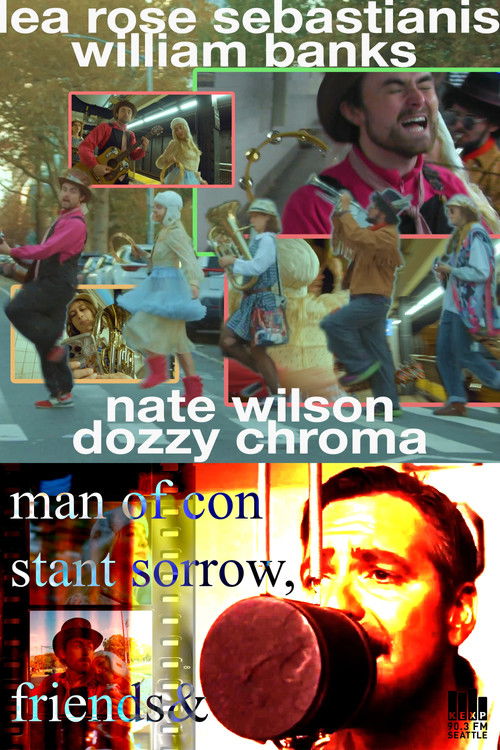
friends& - Man of Constant Sorrow (2026)
Directed by Nate Wilson
No · Based
How we score movies →Consciousness Markers
The central conceit, reckoning with the commercialization of indie rock, is an anti-capitalist gesture in the classic bohemian tradition. It is the anxiety of selling out rendered as street theater, which is at least adjacent to the marker even if it predates the current idiom.
The ensemble cast has visible diversity without the project appearing to foreground it as a statement. It reads as incidental to the Williamsburg milieu rather than programmatic box-checking.
The premise carries a built-in thesis about authenticity and commercialization, and a music video with a stated argument about indie rock's soul is, by definition, making a point. It stops short of sermonizing, largely because ketamine and emotional abuse are not standard homiletic devices.
The futuristic reimagining of 00s indie rock culture as a kind of deranged street performance constitutes a mild revisionist lens on a specific cultural moment, though it functions more as nostalgia critique than historical revision.
The central female character, Lea Rose Sebastianis, exists as a co-equal protagonist in the band's unraveling, but the narrative frames her descent alongside her male counterpart without any discernible feminist commentary.
No LGBTQ+ themes, characters, or messaging are present or referenced in the available material.
There is no racial consciousness framing, discourse about racial identity, or commentary on race present in the project's stated themes or execution.
No climate themes are present. The film is concerned with Pitchfork scores, not carbon scores.
No body positivity themes are present or implied in the available material.
No neurodivergence themes are present or implied in the available material.
Synopsis
the friends& man of constant sorrow music video is about loving 00s indie rock music while reckoning with its commercialization. the video imagines a futuristic stomp-clap band that makes the streets of Williamsburg their stage — like a demented arcade fire or edward sharpe and the magnetic zeros. tormented by a 5.7 pitchfork score, the couple at the centre of the band, played by william banks and lea rose sebastianis, descend into a frenzy of ketamine use and emotional abuse. directed by nate wilson and dozzy chroma.
Why it received this score
Here, at last, is a music video that understands the true tragedy of the 2000s indie rock era: not the music itself, but the Pitchfork score. A 5.7. The film lingers on this number like a coroner noting cause of death. Director Nate Wilson, working alongside Dozzy Chroma, has constructed a short work about the specific grief of caring deeply about something that the internet has already decided is mid, and he has done so by setting it in a futuristic Williamsburg populated by stomp-clapping street performers who behave as though Arcade Fire never stopped being important. This is, in its way, a document of a very particular kind of suffering.
The anti-commercialization thesis sits at the center of the project with the confidence of a man wearing a vintage flannel to a board meeting. The video's concern with selling out belongs to a long and honorable tradition of bohemian anxiety that stretches back well before the current cycle of social consciousness reached its present intensity. What is notable is how the film deploys its critique: not through earnest speechifying, but through the image of two people dissolving into ketamine use and mutual emotional destruction because the algorithm did not love them back. The lecture energy is present, but it is at least wearing interesting clothes. The anti-capitalist undercurrent is real, though it is the anti-capitalism of someone who genuinely loved LCD Soundsystem, not of someone who has read the syllabus.
The social markers here are sparse. The cast is diverse in the way that a Williamsburg street corner simply is diverse, without apparent programmatic intent. There are no LGBTQ+ themes, no climate concerns, no body positivity messaging. This is a film about indie rock grief, and indie rock grief is, historically, a very specific and not especially intersectional affliction. The project scores low across most of our diagnostic criteria, which is either a mark of artistic focus or evidence that the filmmakers were too busy reckoning with their Pitchfork score to attend to the fuller curriculum of contemporary cultural obligations. Both explanations are plausible.
Analysis generated by our Consciousness Algorithm