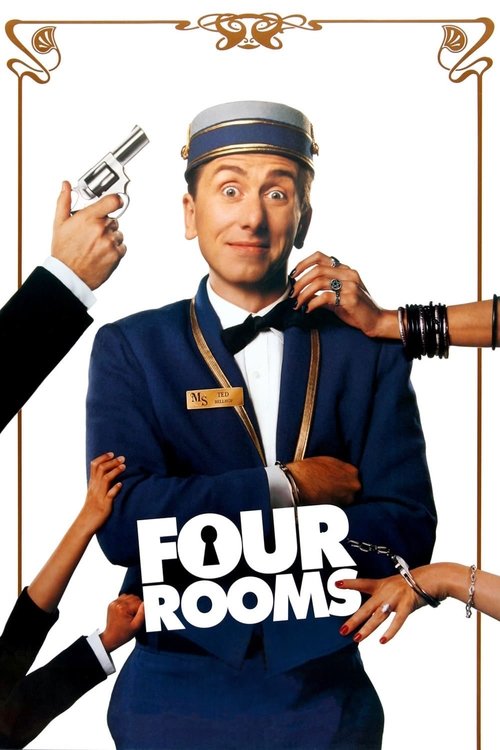
Four Rooms (1995)
Directed by Robert Rodriguez
No · Ultra Based
How we score movies →Consciousness Markers
The cast includes actors of various backgrounds, but their presence functions primarily as celebrity cameos rather than intentional representation. Jennifer Beals and Ione Skye are featured, but within a framework designed for exploitation rather than empowerment.
While female characters appear throughout, they exist primarily as objects of male desire and comedic scenarios. There is no feminist consciousness or critique of gender dynamics, merely the presence of women within a fundamentally male-centered narrative.
While the film does not engage in explicit preaching, some vignettes contain moments where characters articulate desires or philosophies, though these are presented comedically rather than heavy-handedly.
There is no evidence of LGBTQ+ themes, representation, or commentary in the film. No characters are coded as or explicitly identified as LGBTQ+.
Despite the presence of characters from various racial backgrounds, there is no evidence of progressive racial consciousness. Some characterizations appear to rely on stereotypes treated as comedic fodder rather than any form of critical engagement.
There is no climate-related content, environmental messaging, or ecological consciousness in the film.
While the film depicts a service worker protagonist, there is no critique of capitalism or systemic economic inequality. The setting is merely a backdrop for transgressive comedy.
There is no body positivity messaging or celebration of diverse body types. The film treats bodies primarily as objects for comedic or sexual scenarios.
There is no representation of or commentary on neurodivergence in the film.
The film contains no historical content or revisionist framing of past events.


Synopsis
It's Ted the Bellhop's first night on the job...and the hotel's very unusual guests are about to place him in some outrageous predicaments. It seems that this evening's room service is serving up one unbelievable happening after another.
Why it received this score
Four Rooms presents itself as a mid-1990s exercise in transgressive comedy, a collection of vignettes designed primarily to shock and titillate rather than interrogate or educate. The film operates entirely outside the framework of contemporary social consciousness, treating its premise (a beleaguered bellhop servicing increasingly outrageous guest requests) as mere scaffolding for crude humor and sexual scenarios. Director Robert Rodriguez and co-writer Quentin Tarantino construct a space where the comedy derives from escalating absurdity and boundary-pushing rather than any form of progressive commentary or cultural awareness.
The presence of diverse casting and female characters might initially suggest some engagement with representation, but the execution reveals a film fundamentally unconcerned with how it depicts its subjects. Women appear primarily as objects within male-centered comedic scenarios, and the film's treatment of racial and ethnic characterization relies on stereotypical tropes presented as punchlines. There is no evidence of feminist consciousness, racial awareness, or any interrogation of power structures, merely the fact that actors of various backgrounds occupy the frame.
This is a film of its era, a product of Miramax's 1990s aesthetic of provocation for its own sake. The absence of climate consciousness, neurodivergence representation, body positivity, revisionist history, or anti-capitalist critique is total and unremarkable. Even the minimal lecture energy present is comedic rather than preachy. Four Rooms exists in a cultural moment that predates the specific markers we use to measure contemporary progressive sensibilities, and it has aged into a relic of a different era's understanding of transgression.
Analysis generated by our Consciousness Algorithm
Critic Reviews
“Four Rooms, the 4 part directed, 4 part written mix-matched movie turns out to be an awesome combination. With Robert Rodriguez and Quentin Tarantino working on this film, you seem to expect a trigger-happy film festival with plenty of bombs and explosives to spare.”
“It's New Year's Eve, and Ted the Bellhop (Roth) is a very busy man, tending to a coven of witches, an angry husband with a gun, two misbehaving kids, and some Hollywood ...”
“"Four Rooms" comes billed as a film made by four friends. If they are still friends after finishing this film, that says a lot for their friendship.”
“Four Rooms, a four-segment anthology directed by independent film darlings Allison Anders, Alexandre Rockwell, Robert Rodriguez, and Quentin Tarantino, has to be one of 1995's major disappointments.”