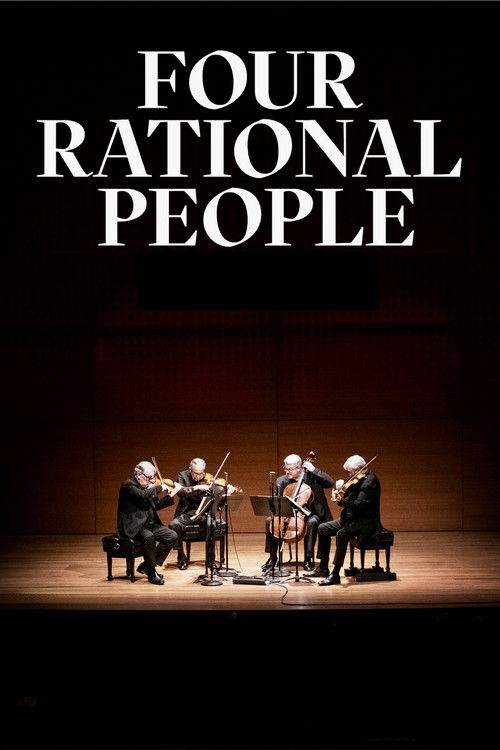
Four Rational People (2025)
Directed by Tristan Cook
No · Ultra Based
How we score movies →Consciousness Markers
The film presents aging bodies without shame or euphemism, depicting the physical realities of four musicians in their seventies and eighties. This normalization of aging bodies carries a subtle counter-cultural force in a youth-obsessed society.
The cast consists of four white male musicians and one white male violist, reflecting the historical composition of classical music institutions rather than any deliberate casting choice. The film does not address this homogeneity.
The film implicitly critiques the instrumentalization of aging bodies and the cultural disposition to discard artists past their commercial peak, but this critique is understated and emerges from artistic rather than explicitly political concerns.
The film contains no explicit feminist agenda. While it does explore emotional vulnerability and the devaluation of aging bodies, these observations emerge from universal human experience rather than gender-specific analysis.
The documentary does not engage with racial themes or examine the racial composition of classical music institutions. The quartet members are all white, but the film treats this as unremarkable rather than something requiring critical examination.
The film maintains a documentary observational style with minimal voiceover or explanatory narration. It trusts viewers to draw their own conclusions rather than delivering preachy lessons about aging, mortality, or artistic legacy.
The documentary presents the Emerson String Quartet's fifty-year history straightforwardly without attempting to reinterpret historical events or challenge established narratives about the ensemble.
No LGBTQ+ themes or representation appear in the film. The documentary focuses entirely on musical legacy and aging without addressing sexual orientation or gender identity.
Climate themes are entirely absent from the film. The documentary concerns itself with personal and artistic matters rather than environmental consciousness.
Neurodivergence is not addressed or represented in the documentary. The film does not engage with disability or neurodivergent themes.
Synopsis
The Emerson String Quartet embarks on the final season of a fifty-year history that includes 9 GRAMMYs and thousands of concerts. Interweaving vivid memories with delicate observations of life on the road, the film explores the difficult decision to walk away from the things they cherish: the music they play and the friends they hold dear. At once a frank examination of the tyranny of aging and a cri de cœur to pass the torch to a new generation, the film culminates with one final performance, leaving all to ponder what happens to us after the final curtain.
Why it received this score
Tristan Cook's documentary arrives as a masterclass in restraint, a quality that has become nearly extinct in contemporary cinema. The film concerns itself with four aging musicians saying goodbye to the only professional relationship that has defined their adult lives, and it treats this subject with the gravity of a Shakespearean tragedy, which is to say, with none of the contemporary urge to retrofit meaning onto suffering. The Emerson String Quartet's final season is presented as a purely human matter: the ache of impending obsolescence, the complicated bonds forged through decades of collaboration, the question of what remains when the music stops. This is not a film interested in declaring anything about society. It simply watches and listens.
What minimal progressive sensibilities the film possesses emerge organically from its engagement with generational succession. The quartet members speak of passing the torch to younger artists with what reads as genuine enthusiasm rather than performative obligation. The film's examination of aging itself, presented without sentimentality or euphemism, carries an implicit critique of a culture that discards aging bodies from public view. Yet these observations arise naturally from the material rather than being imposed upon it. There is no lecture here, no moment where a talking head explains what we should think about mortality or institutional memory.
The documentary's restraint extends to its formal choices. Cook allows extended passages of music, permits silences, trusts his subjects to articulate their own experience. The result is a film that feels almost antique in its commitment to observation over commentary. In an era when every documentary seems obligated to position itself within some larger cultural argument, "Four Rational People" commits the quiet rebellion of simply documenting what it sees. This is not progressive cinema performing progressivism. This is a film about art, time, and the human capacity to create beauty in the face of inevitable decline.
Analysis generated by our Consciousness Algorithm