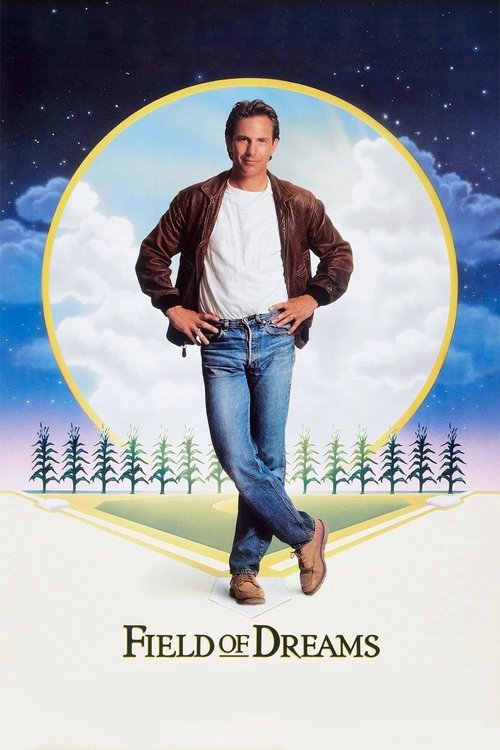
Field of Dreams (1989)
Directed by Phil Alden Robinson
No · Ultra Based
How we score movies →Consciousness Markers
James Earl Jones appears as a respected character, and the film contains mild commentary on baseball history and American racial injustice, though this remains secondary.
Philosophical dialogue appears, particularly from the Terence Mann character, but remains integrated into narrative rather than delivered as explicit preachy lecture.
The Terence Mann character expresses some critique of American consumerism and corporate culture, but this is not a central thematic concern.
Amy Madigan's character is intelligent and skeptical but remains fundamentally supportive of the male protagonist's vision, with the narrative centered on male redemption.
The cast is predominantly white with James Earl Jones in a supporting role, reflecting 1989 conventions rather than conscious representation efforts.
No LGBTQ+ themes, characters, or content appear in the film.
No environmental consciousness or climate-related themes are present in the film.
No body positivity messaging or engagement with bodily diversity is present.
No representation of or engagement with neurodivergent characters or experiences appears in the film.
While baseball history is referenced, there is no revisionist historical reframing in the progressive sense.


Synopsis
Ray Kinsella is an Iowa farmer who hears a mysterious voice telling him to turn his cornfield into a baseball diamond. He does, but the voice's directions don't stop -- even after the spirits of deceased ballplayers turn up to play.
Why it received this score
Field of Dreams is a fundamentally retrograde text dressed in the garments of whimsy and sentimentality. The narrative privileges the male protagonist's vision and redemption arc above all else, with his wife functioning primarily as a grounding device for his increasingly elaborate fantasy. The film's engagement with race is limited to the respectful inclusion of James Earl Jones in a supporting role, accompanied by some mild commentary on baseball history and American injustice, but this remains peripheral to the central preoccupation with masculine reconciliation and the mythic power of sport.
The film's philosophical dimensions are delivered through measured dialogue rather than hectoring monologue, and its anti-establishment impulses are sufficiently diffuse as to register as background texture. We encounter no interrogation of gender roles, no celebration of bodily diversity, no consideration of systemic oppression as a matter requiring active deconstruction. The father-son dynamic that anchors the narrative operates within traditional frameworks of male bonding and emotional expression mediated through baseball, a sport that carries its own historical baggage regarding integration and inclusion, which the film does not meaningfully examine.
As a product of 1989, Field of Dreams cannot be faulted for failing to anticipate the specific cultural concerns of 2024. It is instead a thoroughly conventional fantasy about yearning, faith, and masculine redemption, executed with craftsmanship and sincerity but entirely innocent of progressive cultural consciousness. It belongs to an earlier era of American filmmaking in which such concerns had not yet calcified into the constellation of markers we now recognize as characteristic of contemporary social consciousness.
Analysis generated by our Consciousness Algorithm
Critic Reviews
“This is the kind of movie Frank Capra might have directed, and James Stewart might have starred in - a movie about dreams.”
“What it's really about is taking a second chance to make good on old regrets and dead hopes. Never mind the baseball, this is one for the heart, made beautifully.”
“A work so smartly written, so beautifully filmed, so perfectly acted, that it does the almost impossible trick of turning sentimentality into true emotion.”
“To be honest, I started hearing things, too. Just when Jones was delivering an inexcusably sappy speech about baseball being "a symbol of all that was once good in America," I heard the words "If he keeps talking, I'm walking."”