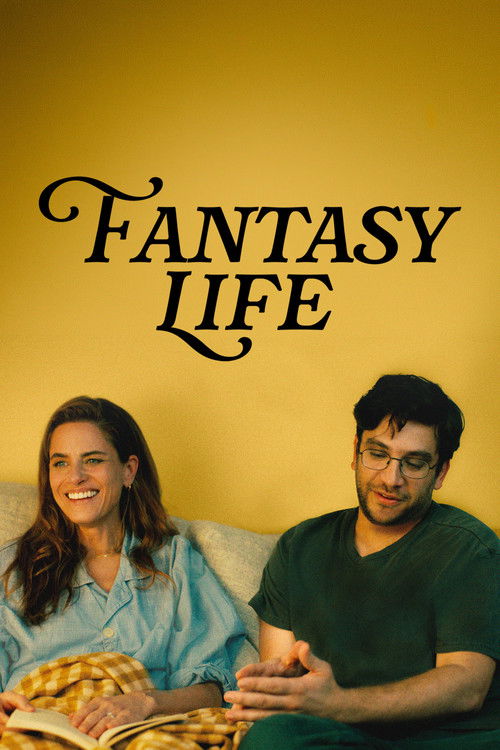
Fantasy Life (2026)
Directed by Matthew Shear
No · Ultra Based
How we score movies →Consciousness Markers
Anxiety is not incidental here but structural: the protagonist is defined by it, his psychiatrist is a named character, and critics specifically flag the film's engagement with mental health humor and nuance. The film treats psychological instability with more intentionality than most.
The central female character is an actress navigating a failing marriage while raising three daughters, and Amanda Peet also serves as producer. The film engages with women's autonomy at the level of character drama, stopping well short of advocacy.
The ensemble skews heavily toward established white character actors, with Sheng Wang present in a supporting capacity. There is no discernible effort to assemble a cast in service of a diversity mandate.
The protagonist's identity as a law school dropout carries a faint whiff of professional failure as social commentary, but the film treats this as personal anxiety rather than indictment of capitalist credentialism.
Described as an anti rom-com that deals in messy dynamics, the film appears to resist tidy moral resolution. Critics note nuance rather than messaging, which is, in this era, itself a minor achievement.
No LGBTQ+ characters, themes, or subplots are in evidence. The romantic architecture is resolutely heterosexual.
No themes of racial identity, systemic racism, or racial consciousness are present in any available account of the film.
The film shows no interest in ecological crisis. It is set in New York and concerned entirely with human neurosis, which is its own kind of crisis.
No body positivity themes or messaging are present. Bodies in this film are simply vessels for neurosis, which is a different tradition entirely.
The film is an original contemporary story with no historical setting or revisionist ambitions of any kind.
Synopsis
An anxious New York law school dropout stumbles into a job babysitting his psychiatrist's three granddaughters and falls for the girls' mother, an actress in a rocky marriage.
Why it received this score
Fantasy Life arrives as a specimen of the anxious New York indie, a genre so well-established it has its own neurological fingerprint. Writer-director-star Matthew Shear plays a law school dropout who falls into babysitting work and then into love, which is the kind of career trajectory that reads as either a personal essay or a cautionary tale depending on your tax bracket. The film won the SXSW Audience Award, which means a room full of people in Austin responded warmly to it, and we should weigh that accordingly.
The social consciousness here is modest and largely accidental. Mental health sits at the center of the narrative with some deliberateness: the protagonist's anxiety is not a quirk but a condition, his psychiatrist is a named character with agency, and critics have specifically noted the film's attention to mental health humor and nuance. This is the film's most legible modern marker, and it wears it lightly enough to avoid sermonizing. Amanda Peet's character, an actress in a crumbling marriage, carries the film's quieter feminist undertow, though the film appears more interested in the texture of her situation than in drawing conclusions about it. Peet also produces, which is worth noting as a structural fact, not a political one.
What the film conspicuously lacks is the full apparatus of contemporary progressive cinema: no racial consciousness, no climate anxiety, no LGBTQ+ subplots, no body positivity declarations. It is, in the taxonomy of the current moment, a film about white New Yorkers being complicated at each other, which is a genre that predates the current cultural vocabulary by several decades and shows no particular interest in updating its credentials. The ensemble of veteran character actors, including Judd Hirsch, Bob Balaban, Holland Taylor, and Andrea Martin, reinforces this impression of a film that is more interested in being good than in being current. These are not mutually exclusive goals, but the choice is notable.
Analysis generated by our Consciousness Algorithm