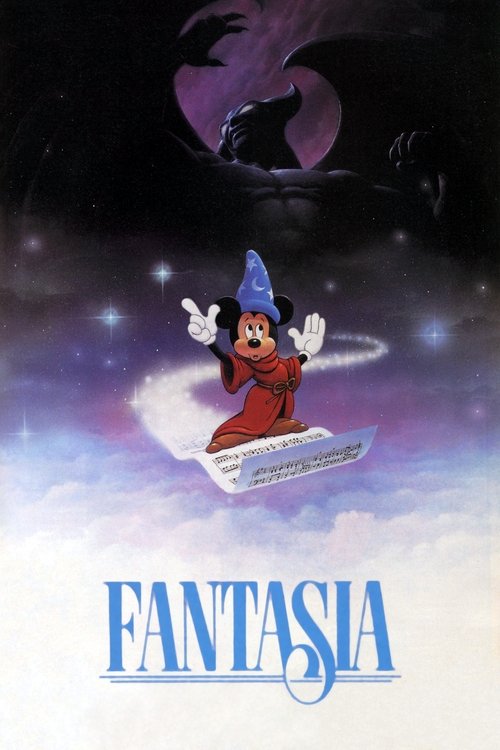
Fantasia (1940)
Directed by Bill Roberts
No · Ultra Based
How we score movies →Consciousness Markers
The film exhibits explicit racial hierarchy through the Centaurette sequence and contains antisemitic imagery in the form of Chernabog. This is not progressive racial consciousness but rather documentation of period prejudice.
The film features a Black centaur character in a subservient, sexualized role serving white characters. This represents not inclusive representation but rather the racial hierarchies of 1940 Hollywood made visual.
Female characters appear primarily in decorative or subservient roles, particularly in the Centaurette sequence. No feminist consciousness is evident in the portrayal of gender.
Deems Taylor provides an occasionally preachy narration explaining the various musical pieces and their visual interpretations, though this is relatively restrained by contemporary standards.
No LGBTQ+ themes or characters present in the film. The work predates any such considerations in mainstream animation.
No climate-related themes or messaging present. The film is purely concerned with the visualization of classical music.
No anti-capitalist messaging or critique present. The film contains no commentary on economic systems or class structures.
The film presents idealized, conventionally attractive bodies throughout. No body positivity messaging or representation of diverse body types exists.
No neurodivergent characters or themes present in the film. The work shows no awareness of neurodiversity as a concept.
The film contains no historical narrative or revisionist claims. It is purely abstract and representational animation paired with classical music.


Synopsis
Walt Disney's timeless masterpiece is an extravaganza of sight and sound. See the music come to life, hear the pictures burst into song and experience the excitement that is Fantasia over and over again.
Why it received this score
Fantasia occupies a peculiar position in the historical record. Released in 1940, this experimental animation feature represents a genuine artistic achievement, a bold attempt to synthesize classical music with visual spectacle in ways that few filmmakers had previously attempted. The technical mastery on display remains impressive even by contemporary standards. Yet the film cannot escape the historical moment of its creation, which is to say that it was created in a moment when certain depictions were considered not merely acceptable but unremarkable. The Centaurette sequence, depicting a Black centaur character serving as a handmaiden to a white centaur, carries all the hallmarks of the casual racial hierarchy that Disney animators accepted without question. This is not accidental or peripheral to the film's structure. It is woven into the very fabric of one of its central set pieces.
The film's other sequences contain their own register of troubling choices, though fewer are as explicitly racialized as the Centaurette material. Chernabog, the demonic figure in Night on Bald Mountain, trades in antisemitic caricature of the demonic other. The overall effect is a film of genuine artistic ambition that is inextricably bound up with the cultural prejudices of its era. We cannot extract the artistry from its context, nor should we pretend that these sequences are incidental rather than structural. The film represents not modernity's progressive impulses but rather the specific moment before those impulses took hold. It is a historical document of what mainstream American entertainment looked like when certain hierarchies were simply assumed to be natural and inevitable.
Scoring Fantasia presents the critic with a difficult task, not because the film is ambiguous, but because it is so clearly a product of its moment. The presence of problematic racial imagery is not a matter of interpretation but of historical fact. The film does not exhibit the markers of contemporary progressive cultural consciousness, nor could it, given that it predates by decades the social movements that would make such consciousness possible. This is not to excuse the imagery but to locate it historically. A score of 15 reflects the film's genuine artistic merits balanced against its unambiguous participation in the racial hierarchies of 1940 Hollywood. The film is neither a beacon of progressive values nor a relic to be dismissed entirely, but rather a complicated artifact that rewards neither uncritical celebration nor simple condemnation.
Analysis generated by our Consciousness Algorithm
Critic Reviews
“A masterpiece of the art of animation. The concept and some of the episodes are tainted with kitsch, but there's no other animated film with its scope and ambition—it is, in Otis Ferguson's words, “one of the strange and beautiful things that have happened in the world.””
“Throughout Fantasia, Disney pushes the edges of the envelope. ”
“Fantasia is simply terrific—as terrific as anything that has ever happened on a screen.”
“This is a very patchy affair - while some of the animated pieces work, others come across as downright insane.”