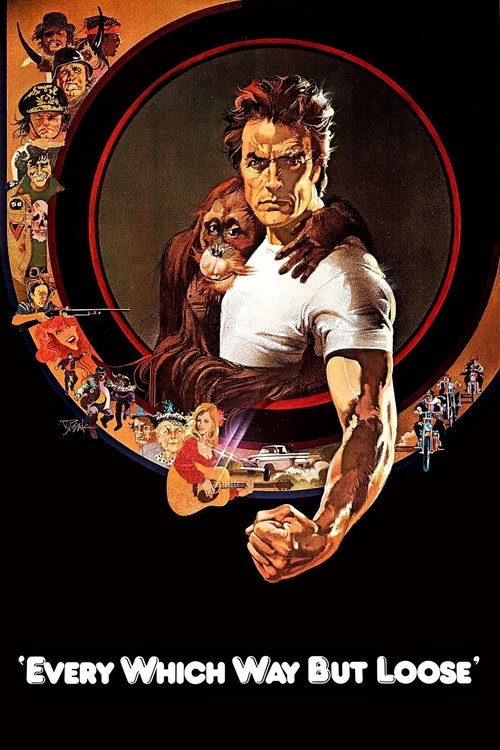
Every Which Way but Loose (1978)
Directed by James Fargo
No · Ultra Based
How we score movies →Consciousness Markers
The cast is predominantly white and male. Sondra Locke and Beverly D'Angelo appear but occupy secondary, decorative roles. No meaningful representation of marginalized groups exists in the narrative.
The film contains no racial awareness whatsoever. A Black actor appears in the cast, but there is no engagement with race as a meaningful social category or source of experience.
The female characters are objects of pursuit rather than agents of their own stories. The love interest exists to be won. There is no interrogation of gender roles or patriarchal structures.
The protagonist is a working-class truck driver, but this is presented uncritically as an adventure fantasy. There is no examination of economic systems or class consciousness.
There are no LGBTQ+ themes, characters, or subtext whatsoever. The film is entirely heteronormative and makes no attempt to acknowledge alternative identities or relationships.
Environmental concerns are entirely absent. The film celebrates truck driving and masculine conquest without any consideration of ecological impact.
The film contains no body positivity messaging. Female bodies are presented for visual consumption according to conventional 1970s standards without commentary or critique.
There is no representation of neurodivergent characters or acknowledgment of neurodiversity. The film operates within conventional neurotypical frameworks without question.
This is not a historical film, so revisionist history is not applicable. The narrative is set in a contemporary 1970s present.
The film contains no preachy moments, no characters who explain social issues, no moral lectures. It simply narrates its action without self-consciousness.


Synopsis
Philo Beddoe is your regular, easygoing, truck-driving guy. He's also the best bar-room brawler west of the Rockies. And he lives with a 165-pound orangutan named Clyde. Like other guys, Philo finally falls in love - with a flighty singer who leads him on a screwball chase across the American Southwest. Nothing's in the way except a motorcycle gang, some cops, and legendary brawler Tank Murdock.
Why it received this score
Every Which Way but Loose stands as a masterclass in pre-consciousness filmmaking, a relic from an era when the entertainment industry had not yet developed the critical apparatus required to interrogate its own assumptions. The film presents itself as a screwball adventure, a straightforward male fantasy about a truck driver, his primate companion, and his romantic pursuits. What emerges beneath this surface is a text thoroughly untouched by the social awareness that would come to define cinema in subsequent decades. The female love interest, played by Sondra Locke, exists primarily as a prize to be won rather than as an autonomous agent with her own narrative weight. She is flighty, undefined, and requires rescue. The male protagonist's violence is not merely excused but celebrated as the very source of his appeal and competence.
The film's universe contains no space for self-reflection regarding gender dynamics, racial representation, or the exploitation inherent in its animal co-star. The motorcycle gang serves as an undifferentiated mass of antagonists, devoid of any complexity or humanity. Violence is the lingua franca through which all conflict is resolved, and the film presents this with the naive enthusiasm of a work that has never considered whether such celebrations might warrant examination. No character pauses to question the morality of their actions. No moment of discomfort suggests that anyone involved in the production recognized the problematic elements embedded in their narrative.
This is not a film that was ahead of its time in any progressive sense, nor does it contain moments that might be read as subversive or ironic. It is simply a product of its era, unmarked by the cultural conversations that would reshape Hollywood in the decades to follow. For those seeking evidence of how thoroughly different the entertainment landscape was before social consciousness became a critical framework, this film provides ample documentation.
Analysis generated by our Consciousness Algorithm
Critic Reviews
“Clint doing roughneck humour with an orang-utan, what's not to like?”
“For Eastwood fans, the essential elements are there. Lots of people get beat up, Eastwood walks tall and looks nasty, cars are crashed. James Fargo directs limply.”
“A huge disappointment after The Outlaw Josey Wales and The Gauntlet, this rambling comedy forsakes the subtle, self-deprecating humour of those films and opts for a far rowdier and broader comedy that never really goes anywhere or says anything. ”
“One can forgive the orangutan's participation - he couldn't read the script - but what is Eastwood's excuse? James Fargo directed, every which way but well. [08 Jan 1979, p.60]”