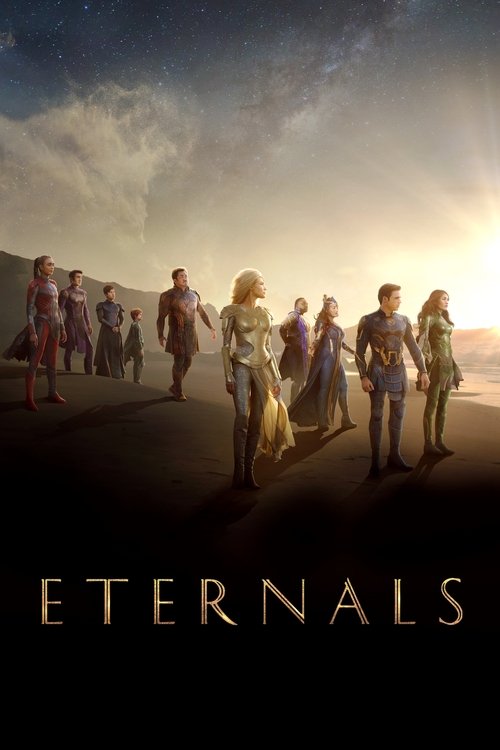
Eternals (2021)
Directed by Chloé Zhao
Yes · Woke
How we score movies →Consciousness Markers
The ensemble cast reflects substantial ethnic diversity with Asian actors (Gemma Chan, Kumail Nanjiani, Don Lee) in lead roles, Latinx representation (Salma Hayek), and a Black male lead in a family-oriented role. This represents deliberate casting decisions to ensure the team does not default to white actors.
Phastos (Brian Tyree Henry) is the MCU's first explicitly gay superhero, depicted as a married man with a husband and son. His family life is central to the narrative rather than incidental, representing a significant marker of LGBTQ+ integration into mainstream superhero storytelling.
Lauren Ridloff's portrayal of Makkari, the MCU's first deaf superhero, represents the film's most explicit neurodivergence marker. Her deafness is neither pathologized nor treated as a deficit, with her superspeed powers presented as integral to her character rather than compensatory.
The casting diversity suggests awareness of racial representation, but the film does not engage in explicit examination of race or racism. The Eternals are presented as a post-racial ensemble of ancient aliens, avoiding confrontation with historical racial dynamics or contemporary racism.
While the film includes female characters in prominent positions (Angelina Jolie as Thena, Gemma Chan as Sersi, Salma Hayek as Ajak), the narrative does not foreground feminist themes or critique patriarchal structures. The female characters function within the ensemble without explicit commentary on gender dynamics.
The film occasionally feels preachy in its presentation of diverse family structures and identities, particularly in scenes involving Phastos and his family, though it generally attempts integration rather than explicit exposition about representation itself.
No evidence of climate advocacy or environmental consciousness in the film. The plot concerns alien threats and internal team conflicts, with no thematic engagement with ecological or climate-related concerns.
The film contains no anti-capitalist themes or critique of wealth accumulation and economic systems. The narrative does not engage with class struggle or systemic economic critique.
No evidence of body positivity messaging or deliberate representation of diverse body types and physical presentations. The cast conforms to conventional superhero aesthetic standards.
The film does not engage in revisionist reinterpretation of historical events or figures. Its narrative of ancient aliens existing across human history avoids specific historical commentary.


Synopsis
The Eternals are a team of ancient aliens who have been living on Earth in secret for thousands of years. When an unexpected tragedy forces them out of the shadows, they are forced to reunite against mankind's most ancient enemy, the Deviants.
Why it received this score
Eternals arrives as Marvel's most ambitious attempt at representation arithmetic, a film that appears to have been constructed by committee memo: one deaf superhero, one gay superhero with a functional family unit, ethnic diversity across the ensemble, and a prestige director in Chloé Zhao to lend gravitas. The result is a blockbuster that checks boxes with admirable thoroughness while remaining fundamentally uncertain whether these elements constitute character development or corporate compliance. Lauren Ridloff's Makkari and Brian Tyree Henry's Phastos represent genuine departures from MCU convention, neither played as sacrificial figures nor as vehicles for inspirational narratives. Makkari's deafness is simply part of her being, present but not fetishized, while Phastos exists within the emotional center of the film as a man with a husband and child rather than as a political statement wearing a superhero suit.
Yet the film's progressive sensibilities operate primarily at the level of casting rather than narrative engagement. The racial and ethnic diversity of the ensemble is presented without interrogation, the characters existing in a post-historical space where their backgrounds matter less than their alien nature. The script avoids any meaningful examination of how these individuals might experience the world differently based on their identities, instead treating diversity as a visual fact rather than a lived reality. When the film does acknowledge its progressive credentials, as in certain scenes with Phastos, it risks sliding into the very lecture energy it claims to transcend, as if the mere presence of a normalized gay family requires explicit recognition.
The film's opening weekend of 71.3 million dollars, fourth best of 2021, suggests audiences were willing to engage with these elements at scale, though mixed critical reception indicates the combination of representation and narrative incoherence created a product that satisfied neither those seeking substantive progressive engagement nor those seeking coherent storytelling. This is a film that represents a transitional moment in blockbuster cinema, one where representation has become non-negotiable but remains somewhat disconnected from thematic purpose. It is the cinematic equivalent of diversity consulting: comprehensive in scope, executed with sincerity, and somehow still vaguely incomplete.
Analysis generated by our Consciousness Algorithm
Critic Reviews
“Zhao keeps these far-reaching propositions grounded through the laser-like focus of her vision and the precision of the images dreamed up by her and veteran MCU lensman Ben Davis. For once in a movie like this, ocean waves and cloudscapes carry as much weight as the ultra-choreographed battles between intergalactic interlopers.”
“While Eternals has most of the benchmarks of a Marvel movie, Zhao's sprawling superhero epic is unlike anything the MCU has produced before.”
“Chloé Zhao gives the MCU just the kick in the pants it needs at this phase in its evolution. ”
“Eternals is like a movie about a horse race that concentrates all its attention on characters that neither own a horse nor like to gamble.”