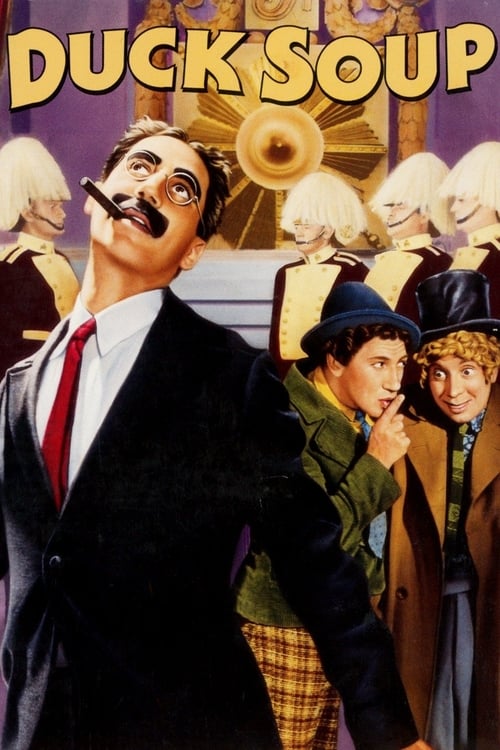
Duck Soup (1933)
Directed by Leo McCarey
No · Ultra Based
How we score movies →Consciousness Markers
The film mocks governmental incompetence and the absurdity of political systems, but does not specifically target capitalism or wealth accumulation as systemic problems.
Margaret Dumont's character Mrs. Teasdale holds wealth and influence, though her agency serves primarily as a plot device for male comedy rather than feminist commentary.
The film contains no conscious effort toward diverse representation. The cast reflects 1930s Hollywood conventions without any apparent commitment to representation activism.
No LGBTQ+ themes, characters, or subtext appear in the film. The romantic plot involves heterosexual courtship in conventional pre-Code style.
The film contains no engagement with racial consciousness or racial themes in any modern sense. The cast is predominantly white, reflecting studio conventions of the era.
Climate and environmental concerns are entirely absent from the film. The focus remains on political satire and war absurdism.
No body positivity messaging appears in the film. Physical comedy relies on conventional notions of the body and beauty.
The film contains no representation of or commentary on neurodivergence. Character eccentricity serves comedic rather than representational purposes.
Duck Soup presents no revisionist historical narrative. It is a fictional satire of fictional nations rather than engagement with actual historical events.
The film maintains pure comedic intent throughout. No preachy lectures or moral instruction appear. The satire operates through humor rather than explanation.


Synopsis
Rufus T. Firefly is named president/dictator of bankrupt Freedonia and declares war on neighboring Sylvania over the love of wealthy Mrs. Teasdale.
Why it received this score
Duck Soup stands as a monument to anarchic political satire, a film in which the Marx Brothers systematically dismantle the machinery of government and war through surrealist humor, rapid-fire dialogue, and calculated absurdism. Leo McCarey's direction allows the comedy to spiral into near-total chaos, where patriotism becomes punchline, nationalism collapses into farce, and the very concept of authority is subjected to relentless mockery. It is genuinely subversive filmmaking, the work of comedians willing to mock power itself at a moment when such mockery carried real cultural risk. The film's anarchist sensibilities would later resonate with 1960s audiences seeking to question institutional authority through laughter.
Yet we must recognize the crucial distinction between being politically transgressive in a general sense and embodying the specific markers of contemporary progressive consciousness. Duck Soup is anarchist, anti-establishment, and skeptical of nationalism. These are not the same as modern cultural awareness around representation, identity, and systemic inequality. The film contains no conscious engagement with race, gender, sexuality, or the other vectors through which modern progressive sensibility operates. It is simply very funny people being very funny about power.
The Marx Brothers' Jewishness was itself transgressive for 1933 American cinema, and their status as immigrants and outsiders informed their outsider perspective on authority. But this remains a matter of biographical fact rather than thematic representation. Duck Soup endures as a masterpiece of comedy and as a document of anarchist humor, but it occupies a different cultural universe from the progressive filmmaking of subsequent decades. It is a relic of when subversion meant chaos rather than consciousness.
Analysis generated by our Consciousness Algorithm
Critic Reviews
“There is an odd moment when Harpo shows Groucho a doghouse tattooed on his stomach, and in a special effect a real dog emerges and barks at him. The brothers broke the classical structure of movie comedy and glued it back again haphazardly, and nothing was ever the same.”
“The Marx brothers on top form with their quickfire comedy and banter.”
“A production in which the bludgeon is employed more often than the gimlet. The result is that this production is, for the most part, extremely noisy without being nearly as mirthful as their other films.”