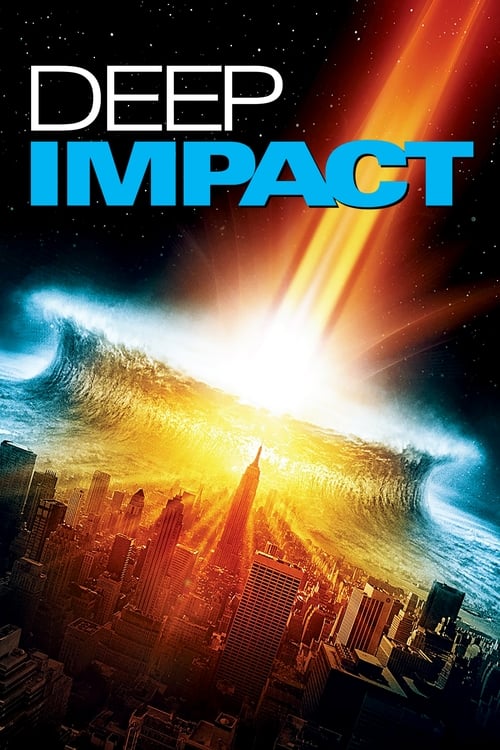
Deep Impact (1998)
Directed by Mimi Leder
No · Ultra Based
How we score movies →Consciousness Markers
The cast includes Morgan Freeman and Vanessa Redgrave, providing demographic diversity, though this appears incidental rather than intentional representation strategy.
Téa Leoni's reporter character provides female agency and a protagonist role, but the film makes no particular effort to foreground feminist themes or critique patriarchal structures.
Morgan Freeman's casting as President is notable but presented without particular racial consciousness or commentary. His race is not thematized in the narrative.
Minimal preachy messaging. The film prioritizes spectacle and action over social commentary or educational content about progressive themes.
No LGBTQ+ themes, characters, or representation present in the film. Relationships are entirely heterosexual and conventional.
No environmental consciousness or climate-related messaging present. The threat is cosmic rather than terrestrial or human-caused.
Standard disaster film with no critique of capitalism, class structures, or institutional power. Government and military institutions are presented as benevolent problem-solvers.
No body positivity messaging or representation of diverse body types. Cast members conform to conventional Hollywood standards.
No representation of neurodivergence or discussion of disability. Not relevant to the film's narrative.
No historical elements to revise or reinterpret. The film is set in a contemporary (for 1998) near-future with no engagement with history.


Synopsis
A seven-mile-wide space rock is hurtling toward Earth, threatening to obliterate the planet. Now, it's up to the president of the United States to save the world. He appoints a tough-as-nails veteran astronaut to lead a joint American-Russian crew into space to destroy the comet before impact. Meanwhile, an enterprising reporter uses her smarts to uncover the scoop of the century.
Why it received this score
Deep Impact arrived in 1998 as a straightforward disaster spectacle, directed by Mimi Leder during an era when such films rarely concerned themselves with the cultural consciousness that would later define the 2020s discourse around progressive sensibilities. The film features a reasonably diverse cast, with Morgan Freeman's President and Vanessa Redgrave among the ensemble, but this casting appears incidental rather than the result of intentional representation strategy. Téa Leoni provides a female protagonist in her reporter character, though the film makes no particular effort to foreground feminist themes or subvert traditional gender dynamics.
The narrative structure cleaves to the disaster film template established decades prior, prioritizing spectacle and interpersonal drama over any form of social messaging. There is no environmental consciousness despite the cosmic threat driving the plot, no class critique, no interrogation of institutions or power structures. The presence of American-Russian cooperation reflects Cold War thaw rather than any progressive ideology. The film's treatment of family relationships, while emotionally earnest, remains entirely conventional for the era.
This is a film untouched by the cultural markers that would come to define modern progressive cinema. It occupies a space before such concerns became industry standard or even culturally salient. This is neither condemnation nor praise, merely observation. Deep Impact is a product of 1998, asking nothing of its audience except to enjoy the spectacle of planetary destruction and root for competent professionals to solve an existential crisis.
Analysis generated by our Consciousness Algorithm
Critic Reviews
“Deep Impact confines much of its horror to television news reports and has a more brooding, thoughtful tone than this genre usually calls for.”
“Leder establishes a syncopated rhythm unlike anything we're used to in a catastrophe spectacle.”
“You can enjoy the way they create little flashes of wit in the dialogue, which enlivens what is, after all, a formula disaster movie.”
“For a suspense drama, Impact is a slack, oddly enervated and mawkish soup of largely lethargic performances.”