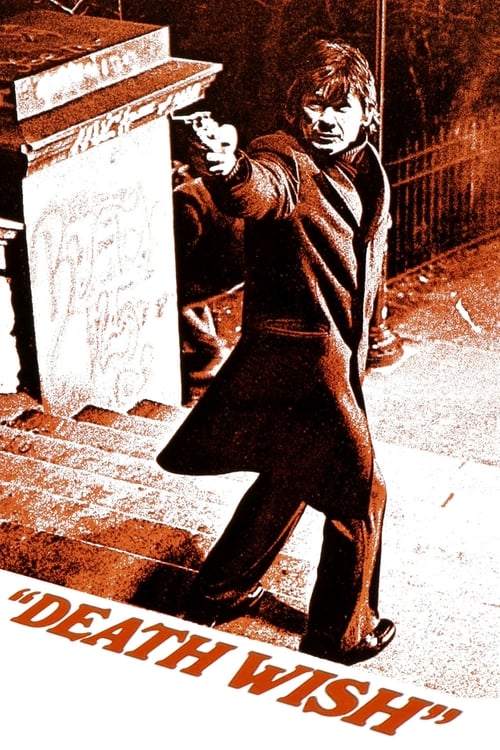
Death Wish (1974)
Directed by Michael Winner
No · Ultra Based
How we score movies →Consciousness Markers
The film does contain a kind of preachy quality about urban decay and the necessity of violent response, though not in the contemporary sense of explicit moral instruction.
The cast is almost entirely white, with supporting characters of color appearing only as criminals or victims. No meaningful representation or nuanced portrayal of diverse backgrounds.
Women exist primarily as victims and motivation for male action. The protagonist's wife and daughter are assaulted to drive the male revenge narrative forward.
The film employs racialized imagery of urban crime without any systemic analysis. Criminals are implicitly depicted as dangerous others, with no exploration of poverty or inequality.
No LGBTQ+ themes, characters, or representation of any kind. The film is entirely heteronormative and does not engage with sexual orientation or gender identity.
No environmental themes or climate consciousness present in the film. The narrative is entirely focused on urban crime and personal revenge.
No critique of capitalism or economic systems. The film celebrates individual property rights and the protection of personal wealth through violence.
No body positivity themes. The film presents a traditional masculine ideal of physical dominance and violence.
No representation or acknowledgment of neurodivergence, mental health, or psychological complexity beyond conventional trauma responses.
No historical revisionism present. The film engages with contemporary 1970s urban crime rather than historical narrative reinterpretation.


Synopsis
After his wife is murdered by street punks, a pacifistic New York City architect becomes a one-man vigilante squad, prowling the streets for would-be muggers after dark.
Why it received this score
Death Wish is a film so thoroughly committed to the logic of vigilante justice and masculine regeneration through violence that it would be difficult to construct a better example of pre-contemporary cinema sensibilities. Michael Winner's 1974 thriller presents urban crime as an existential threat that overwhelms institutional order, with the only possible response being the individual man taking the law into his own hands. The film's racial subtext is unmistakable, though entirely unexamined: the criminals who destroy Bronson's world are depicted as urban predators, and the narrative arc validates his descent into extrajudicial killing as heroic restoration of order. This is not sophisticated commentary on systemic injustice but rather a working-class fantasy of violent reclamation.
The casting and character work reveal the film's ideological commitments with admirable clarity. We have Charles Bronson as the wronged everyman, a figure of white masculine victimhood whose response to trauma is not institutional reform but personal annihilation of threats. The women in the film exist primarily as victims and motivation. There is no interrogation of why crime has become so pervasive, no examination of poverty or desperation as root causes, only the assumption that certain people are simply predatory and must be eliminated. The film takes this premise with complete seriousness, never winking at the audience about the moral implications of what it is depicting.
By contemporary standards, Death Wish scores almost entirely in the negative across progressive cultural markers. It was made before such frameworks existed, and it shows. What we witness is a film that is ideologically opposed to nearly every sensibility that would later be classified as contemporary progressive consciousness: it celebrates individual violence over collective reform, depicts urban crime through a racialized lens without acknowledgment of systemic causes, and ultimately argues that the proper response to institutional failure is masculine vigilantism. This is not to say it is a bad film, merely that it is a film whose worldview is orthogonal to modern sensibilities about representation, accountability, and systemic change.
Analysis generated by our Consciousness Algorithm
Critic Reviews
“Death Wish is easily the second best “Death Wish” movie ever made, and not a distant second.”
“A wishy-washy exploitation movie, which doesn’t show any real verve until the climax.”
“Although he races through the occasional blasts of gritty action, Roth slows things down whenever Paul corners one of the people who killed his wife, the director sinking his teeth into long torture sequences or terse dialogue scenes that are punctuated with shocking flashes of gore.”
“At a time when Americans are constantly bombarded with reports of unpunished police brutality, the film suggests that the true problem with justice in our country is that law enforcement isn't violent enough. ”