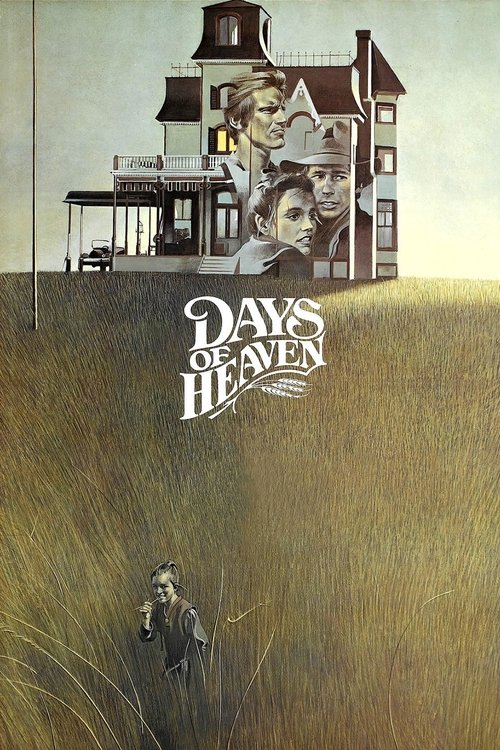
Days of Heaven (1978)
Directed by Terrence Malick
No · Ultra Based
How we score movies →Consciousness Markers
The narrative depicts capitalism's corruptions and the desperation it breeds, showing workers exploited and a protagonist driven to deception by economic need. However, the film presents these observations through poetic ambiguity rather than explicit ideological critique.
While the female protagonist is largely passive and instrumentalized by male schemes, her character is not presented as deserving of this treatment. The film's aesthetic distance allows a viewer to perceive her exploitation, though the work does not explicitly critique gendered power dynamics.
The cast reflects the historical setting without deliberate effort toward representation beyond what the 1916 Texas narrative would naturally contain. No evidence of conscious casting choices aimed at demographic diversity.
The film contains no LGBTQ+ themes, representation, or subtext. The narrative is entirely heterosexual in its romantic and social dimensions.
The film contains no engagement with racial themes or consciousness. The historical setting and narrative do not address racial dynamics or systemic racism.
No environmental or climate-related themes are present. The landscape serves aesthetic and symbolic purposes rather than environmental commentary.
The film contains no body positivity messaging or representation. Bodies are depicted naturalistically as they appear within the historical and narrative context.
No neurodivergence representation or themes are present in the film.
The film depicts 1916 Texas authentically within its artistic vision without rewriting history to serve contemporary political narratives.
Malick's approach is fundamentally poetic and contemplative rather than preachy. The film does not lecture or explain its moral positions to the audience.


Synopsis
In 1916, a Chicago steel worker accidentally kills his supervisor and flees to the Texas panhandle with his girlfriend and little sister to work harvesting wheat in the fields of a stoic farmer.
Why it received this score
Days of Heaven is a 1978 Terrence Malick film of such transcendent visual beauty and philosophical ambition that one might mistake it for something it is not: a work animated by modern progressive sensibilities. The film examines the machinery of capitalism and human exploitation through the lens of rural Texas during World War I, and it does so with a poet's attention to landscape and light rather than a propagandist's fervor. The narrative concerns itself with deceit and moral compromise in service of economic advancement, themes that align with certain critiques of wealth accumulation, yet the film arrives at these observations through aesthetic contemplation rather than explicit social messaging.
The female protagonist, Abby, functions primarily as the object of male desire and economic strategy rather than as an autonomous agent. She is beautiful, compliant, and instrumental to the schemes of the men around her. Her agency is minimal, her voice (when present through narration) belongs to a child observer rather than to the central characters themselves. The working-class laborers are depicted with dignity and humanity, but the film's interest in them is anthropological rather than advocative. We are invited to observe their suffering, not to be moved toward action on their behalf.
Malick's formal mastery produces a work that gestures toward social critique without embracing it. The film is too committed to beauty, to ambiguity, to the mysteries of human motivation to be considered a vehicle for cultural consciousness as the modern era understands it. It is instead a masterwork of cinema that happens to depict exploitation, much as a Dutch still life might contain a skull without being about mortality. The cinematography alone carries the film to Academy Award recognition, and the score by Ennio Morricone provides a haunting emotional framework that transcends any particular ideological commitment.
Analysis generated by our Consciousness Algorithm
Critic Reviews
“Some movies are like Dorothy's twister; they just pick you up and whisk you away from the commonplace world you know to a world wondrous and astonishing. Days of Heaven is such a movie. [27 July 1998]”
“Above all one of the most beautiful films ever made. Malick's purpose is not to tell a story of melodrama, but one of loss. His tone is elegiac. He evokes the loneliness and beauty of the limitless Texas prairie. [7 Dec. 1997]”
“Director Malick endows this simple, timeless story with the enormous scope and resonance of myth through a clear vision unclouded by sentimentality and by a deft juxtaposition of image, music, and character.”
“It is full of elegant and striking photography; and it is an intolerably artsy, artificial film.”