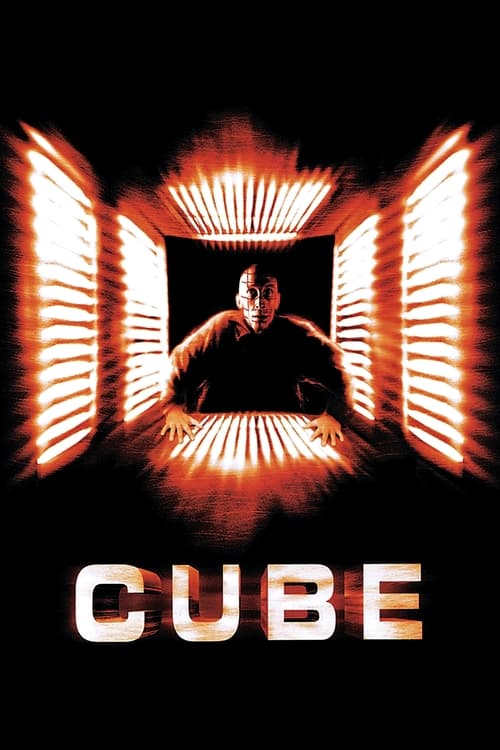
Cube (1998)
Directed by Vincenzo Natali
No · Ultra Based
How we score movies →Consciousness Markers
One character exhibits strong mathematical and pattern-recognition abilities that could suggest autism or similar neurodivergence, though the film does not explicitly frame or discuss this.
The ensemble cast includes racial and gender diversity, but this appears incidental to the narrative rather than intentional representation or commentary on systemic exclusion.
One female character participates equally in the survival scenario, but the film contains no explicit feminist agenda or commentary on gender.
The maze could be interpreted as a metaphor for oppressive systems, but the film does not explicitly foreground or develop any anti-capitalist critique.
Characters occasionally explain geometric concepts or maze mechanics, but the film is primarily visual and atmospheric rather than preachy.
No LGBTQ+ themes, characters, or subtext are present in the film.
The film does not engage with racial themes, systemic racism, or any form of racial consciousness.
No environmental messaging or climate-related themes are present.
The film contains no body positivity messaging or commentary on body image.
The film is not set in a historical period and contains no revisionist historical elements.


Synopsis
A group of strangers find themselves trapped in a maze-like prison. It soon becomes clear that each of them possesses the peculiar skills necessary to escape, if they don't wind up dead first.
Why it received this score
Cube arrives as a purely mechanical exercise in geometric horror, a low-budget Canadian production that treats the maze as both literal and metaphorical prison without pausing to interrogate the systems that built it. The film's concerns are survival and the abstract mathematics of its titular structure, not the social hierarchies or power dynamics that might inhabit such spaces. The cast includes a woman and a Black man among its ensemble, but these appear to be casting choices rather than statements about representation. One character displays an aptitude for mathematics and pattern recognition that might suggest neurodivergence, though the film remains indifferent to the concept. The maze itself could be read as a critique of bureaucratic systems, yet such readings require us to import meaning the film does not offer. Natali's vision is fundamentally apolitical, concerned with the visceral experience of confinement and the steady attrition of hope. This is a film from 1998 that remains precisely of 1998, untouched by the cultural movements that would crystallize in the following decades.
Analysis generated by our Consciousness Algorithm
Critic Reviews
“For his first feature, Canadian director Vincenzo Natali has, like the setting of his film, created a complex piece of work around an essentially simple foundation.”
“Even though there are tedious stretches with less-than-riveting characters, the film gradually pulls you into its claustrophobic spell and becomes acutely suspenseful in its final half-hour.”
“Although character arcs are a little too abruptly truncated as the story moves, Natali never fumbles the big picture.”
“It's an existential, Kafka-esque nightmare with no real resolution, although if you've been biding your time waiting to see some high-strung, ham-handed bickering on-screen, this is your A-ticket.”