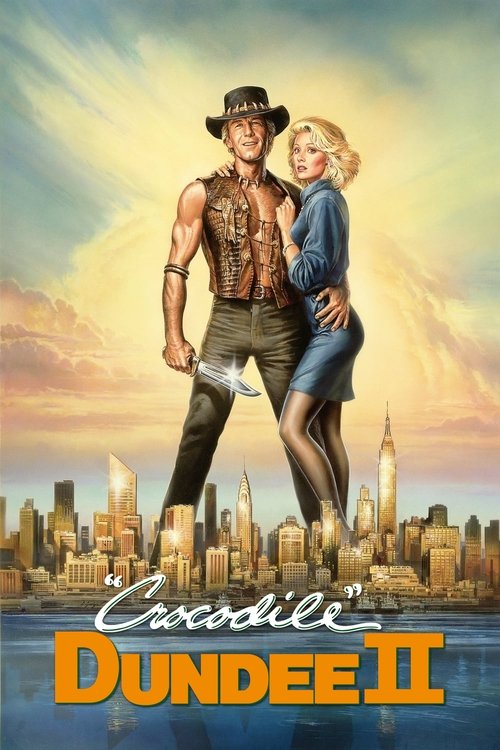
Crocodile Dundee II (1988)
Directed by John Cornell
No · Ultra Based
How we score movies →Consciousness Markers
Ernie Dingo appears in a credited role as an Aboriginal character, which was notable for 1988 Australian cinema. However, the character serves a functional narrative purpose without any cultural specificity or examination of Indigenous experience.
The film uses Aboriginal Australian characters and the outback landscape without interrogating colonial history or power dynamics. Inclusion of Ernie Dingo suggests minimal consciousness, but the film contains no explicit racial awareness or critique.
Linda Kozlowski's character Sue is present primarily as the object requiring protection and rescue by the male protagonist. She demonstrates agency in isolated moments but exists within a fundamentally patriarchal narrative structure.
The antagonists are criminals rather than representatives of systemic inequality. Their defeat poses no challenge to capitalist structures. The film contains no critique of wealth, power, or economic systems.
The film maintains a light comedic tone throughout and contains no preachy moments or explicit moral instruction. However, moments where Aboriginal characters interact with the protagonist carry a faint patronizing quality.
No LGBTQ+ themes, characters, or subtext present. The romantic subplot involves heterosexual pairing between Mick and Sue without complication or progressive framing.
No environmental themes, climate concerns, or ecological consciousness present. The Australian landscape is portrayed as a playground for adventure rather than as an ecosystem requiring protection.
The film celebrates conventional muscular action-hero physiology. No diversity of body types appears in significant roles. No commentary on body standards or appearance exists.
No neurodivergent characters or themes present. No acknowledgment of disability, mental health, or cognitive difference appears in the narrative.
The film contains no historical narrative of any kind. It makes no claims about the past and engages in no revisionist project, progressive or otherwise.


Synopsis
Australian outback expert protects his New York love from gangsters who've followed her down under.
Why it received this score
Crocodile Dundee II arrives from a distant era when the primary concern was whether a film could sustain an action-comedy premise across ninety minutes, not whether it adequately centered marginalized perspectives. The film is a straightforward adventure romp in which our bronzed Australian protagonist rescues his American girlfriend from New York mobsters by transporting the conflict to the Australian outback. It contains what we might charitably describe as a pre-conscious approach to representation, which is to say it contains representation without any apparent awareness that representation required conscious thought.
The film's most significant marker of modern progressive sensibility is the presence of Ernie Dingo, an Aboriginal Australian actor, in a credited supporting role. However, the film offers no examination of Indigenous experience, no acknowledgment of historical injustice, and no suggestion that Aboriginal Australians possess any particular claim to the landscape being used as backdrop for white action heroics. Dingo's character exists as a functional element of the narrative rather than as a subject worthy of cultural consideration. This is not representation in the modern sense. It is casting.
The film contains no LGBTQ+ themes, no feminist critique, no climate consciousness, no anti-capitalist sentiment, and no particular interest in bodies outside conventional action-hero physiology. Its gangsters are generic obstacles rather than critiques of capitalism. Its violence is presented as entertainment divorced from moral weight. We are not meant to interrogate these choices. We are meant to enjoy watching Paul Hogan catch crocodiles and defeat criminals. In this, Crocodile Dundee II succeeds admirably. As an artifact of modern progressive consciousness, it barely registers. This is not a failure of the film. It is simply a film made before that particular framework existed.
Analysis generated by our Consciousness Algorithm
Critic Reviews
“Crocodile Dundee II is almost as much fun the second time around. As an adventure it's nothing special, yet it's an inspired and good-humored presentation of one of the freshest, most likable screen personalities to emerge in the past decade. [25 May 1988, p.1]”
“Croc, as played by the sinewy and appealing Paul Hogan, may be a fish out of water, but he's a formidable comic hero, a kind of Outback James Bond only less perturbable. And this sequel is actually a better film than the original, which was one of the movies' least likely success stories in 1986. [25 May 1988, p.D1]”
“Crocodile Dundee II has been attractively photographed, if unremarkably directed, and it aims for affable, low-key escapism just as the first film did. But the earlier one had novelty to keep it going, and this time the novelty has begun to wear thin, even if Mr. Hogan remains generally irresistible.”
“It is much less understandable, and not at all forgivable, that in eschewing the culture-clash comedy of the first film for generic action, the filmmakers forgot they were making a comedy at all. ”