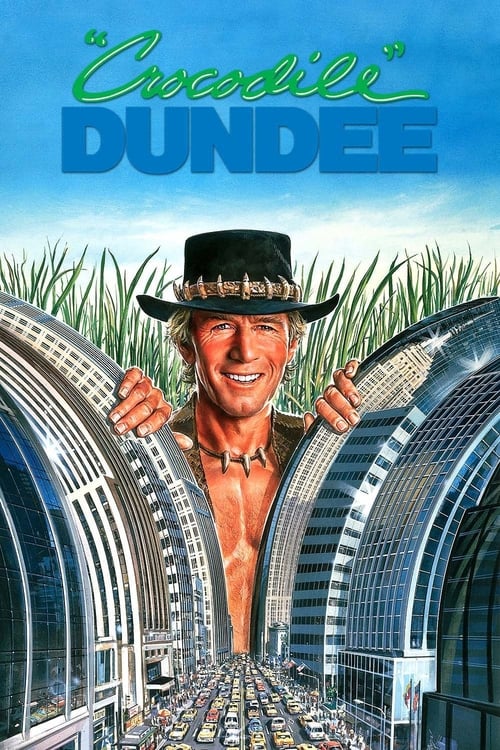
Crocodile Dundee (1986)
Directed by Peter Faiman
No · Ultra Based
How we score movies →Consciousness Markers
Aboriginal characters appear in the cast but are relegated to supporting roles. David Gulpilil's presence does not translate to meaningful representation, as Indigenous Australians function primarily as scenery in a narrative centered on white protagonists.
The film treats Australian Aboriginal culture as exotic backdrop and source of physical prowess rather than as a living culture worthy of respect. Indigenous characters exist to validate the protagonist's skills, not as autonomous beings.
Sue Charlton, despite being the character who initiates the narrative, is systematically positioned as a prize to be won by Mick's superior masculinity. Her agency diminishes as the plot progresses, culminating in romantic conquest rather than mutual partnership.
The film presents Australian colonial history through a lens of adventure and discovery, eliding the violent dispossession of Aboriginal peoples. The Outback is portrayed as empty space awaiting civilization rather than as occupied Indigenous land.
The film contains explicit homophobic humor directed at effete urban male characters. LGBTQ+ individuals are treated as objects of ridicule, with their presentation coded as inherently comic rather than human.
The film celebrates a narrow archetype of masculine physicality (lean, muscular, hyper-capable) while treating bodily difference as comic fodder. No genuine diversity of body types is presented respectfully.
No climate consciousness is present. The natural environment is portrayed solely as a landscape for adventure and conquest, not as something requiring environmental stewardship or protection.
The film contains no critique of capitalism. Mick's transition from working-class bushman to wealthy entrepreneur through tourism is presented as unambiguously positive.
No engagement with neurodivergence whatsoever. Mick's directness and lack of social convention are played for laughs rather than presented as valid alternative modes of being.
The film contains no preachy messaging or moral instruction. Its offenses are encoded in what it treats as normal and acceptable rather than in explicit preaching.


Synopsis
When a New York reporter plucks crocodile hunter Mick Dundee from the Australian Outback for a visit to the Big Apple, it's a clash of cultures and a recipe for good-natured comedy as naïve Dundee negotiates the concrete jungle. He proves that his instincts are quite useful in the city and adeptly handles everything from wily muggers to high-society snoots without breaking a sweat.
Why it received this score
Crocodile Dundee presents itself as a harmless fish-out-of-water comedy, yet beneath the khaki exterior lurks a film so steeped in the regressive attitudes of the mid-1980s that it functions almost as a time capsule of anxieties the culture has since, however imperfectly, begun to interrogate. The Guardian's assessment that the film was "sexist, racist and homophobic" remains the most accurate capsule summary. Sue Charlton, played by Linda Kozlowski, exists primarily as a prize to be won by Mick's superior bushcraft and masculine prowess, her agency systematically diminished in service to his narrative triumph. The film's treatment of its Aboriginal characters, particularly in the casting of David Gulpilil, reduces Indigenous Australians to supporting props in a story about a white man's dominance over nature and civilization alike.
The homophobic elements manifest most acutely in scenes designed to mock effete New York aesthetes through Mick's bewildered responses to urban sophistication. These moments operate on the assumption that certain masculine presentations warrant ridicule, a comedic framework that has aged poorly and reveals the film's fundamental misalignment with any contemporary consciousness regarding sexual orientation or gender expression. The film's worldview centers on a particular strain of masculinity, one that solves problems through physical dominance and treats intellectual or emotional complexity as suspect.
What remains remarkable is how thoroughly Crocodile Dundee sanitizes its own cultural attitudes through the veneer of good-natured comedy. The film was phenomenally successful, grossing over $300 million globally, yet its success cannot be disentangled from an audience that found these same attitudes unremarkable. To revisit it now requires acknowledging not merely that it was problematic, but that mainstream entertainment once celebrated these values without qualification or irony.
Analysis generated by our Consciousness Algorithm
Critic Reviews
“Certainly Crocodile Dundee is nothing you can examine deeply or mull over afterward. It's simply an expert crowd-pleaser. It has such a sure, easy, confident touch that it's almost failure-proof--like a tip of the hat, a sip of beer, a quick, golden G'day.”
“Crocodile Dundee is a breezy, fun affair - a trifle that is extremely pleasant to sample and leaves no bitter aftertaste. ”
“Hogan is an appealing performer, and Kozlowski has a brisk charm as his love interest. Indeed, the film functions far better as romantic comedy than it does as social satire, building an entertaining sexual suspense as an unacknowledged attraction builds between the two leads.”
“For a long time Crocodile Dundee isn't so much a collection of jokes as a stiff-jointed opposites-attract romantic drama goofed up with stereotypes.”