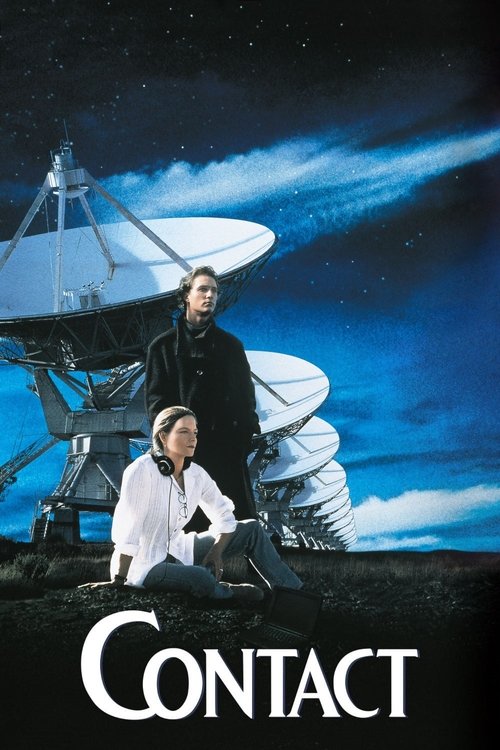
Contact (1997)
Directed by Robert Zemeckis
No · Based
How we score movies →Consciousness Markers
Jodie Foster leads as the protagonist scientist, notable for the era but presented without specific commentary on gender representation or institutional barriers.
Ellie Arroway is a capable professional woman, but the film treats her gender as incidental rather than thematically significant, avoiding feminist critique of institutional sexism.
Philosophical discussions about faith and science are presented as genuine dialogue rather than preachy lectures, maintaining relatively balanced perspective.
Mild institutional skepticism toward government and military, but this reflects 1990s sci-fi convention rather than systemic anti-capitalist ideology.
No LGBTQ+ themes, representation, or narratives present in the film.
No racial themes or consciousness present, despite Angela Bassett's supporting role.
No environmental or climate change themes present in the narrative.
No body positivity themes or commentary present.
No neurodivergent representation or themes present.
The film does not reframe or reinterpret historical narratives.


Synopsis
A radio astronomer receives the first extraterrestrial radio signal ever picked up on Earth. As the world powers scramble to decipher the message and decide upon a course of action, she must make some difficult decisions between her beliefs, the truth, and reality.
Why it received this score
Robert Zemeckis' Contact stands as a curious artifact of 1990s prestige science fiction, a film that appears progressive on its surface but reveals itself, under scrutiny, to be fundamentally conventional in its social consciousness. Jodie Foster anchors the narrative as Dr. Ellie Arroway, a capable female scientist, yet the film treats this casting choice as mere casting rather than statement. She exists in a world of predominantly male military and government officials not because the film wishes to interrogate institutional sexism, but because that was simply what such institutions looked like to the filmmakers. The female lead is presented as exceptional, not as evidence of systemic change.
The film's engagement with faith versus science, its most thematically ambitious element, operates as philosophical inquiry rather than ideological positioning. Matthew McConaughey's priest character receives genuine intellectual respect, and the narrative refuses to position scientific rationalism as the sole arbiter of truth. This balance, while admirable, cannot be mistaken for progressive social consciousness. The film remains essentially apolitical about contemporary power structures, concerned instead with cosmic mysteries and personal spiritual journeys. Its skepticism toward government and military institutions, though present, reads as generic 1990s techno-thriller convention rather than systemic critique.
Contact ultimately succeeds as science fiction spectacle and fails as a vehicle for modern progressive sensibilities. It offers representation without commentary, philosophical debate without ideological commitment, and a female protagonist without feminist framework. For a 1997 film, this represents solid mainstream entertainment. For contemporary classification, it registers as thoroughly inert on the markers of cultural consciousness that define modern progressive filmmaking.
Analysis generated by our Consciousness Algorithm
Critic Reviews
“Contact is that rare big-budget motion picture that places ideas, characters, and plot above everything else. ”
“Contact is superior popular filmmaking, both polished and effective. But despite its success and its serious intentions, it's finally a movie where the storytelling makes more of an impact than the story. ”
“Sagan's novel Contact provides the inspiration for Robert Zemeckis' new film, which tells the smartest and most absorbing story about extraterrestrial intelligence since "Close Encounters of the Third Kind."”
“In some ways, Contact is just like the universe: big, star-bright and seemingly endless. Not to mention that it begins with a big bang, gradually falls into a lull and finally succumbs to entropy.”