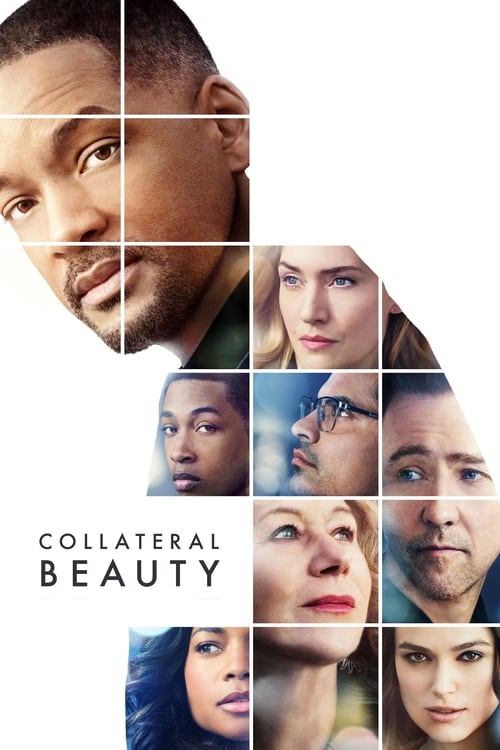
Collateral Beauty (2016)
Directed by David Frankel
No · Ultra Based
How we score movies →Consciousness Markers
The cast includes Michael Peña, Naomie Harris, and Jacob Latimore in supporting roles, providing some racial diversity. However, the narrative does not center on their experiences or perspectives, and they function primarily as supporting players in a story dominated by white leads.
The film employs an allegorical conceit in which characters personify abstract concepts (Love, Time, Death) and deliver philosophical monologues about grief and meaning. While this is integral to the narrative structure, it creates a preachy quality where characters explain emotional and existential themes directly to the protagonist.
While the film includes female characters, particularly Kate Winslet and Keira Knightley, they serve conventional roles in a male-centered narrative. The film does not engage with feminist themes or critique patriarchal structures.
The film centers on wealthy characters in Manhattan and their professional lives but does not critique capitalism or class structures. There is minimal engagement with economic systems.
No LGBTQ+ representation or themes are present in the film. The narrative focuses on heterosexual relationships and grief without any explicit engagement with queer identity or relationships.
The film contains no exploration of racial identity, systemic racism, or racial justice. Race is not addressed as a thematic element in the narrative.
No climate-related themes or environmental consciousness are present in this grief-focused drama about personal loss and philosophical questioning.
The film does not address body image, body diversity, or body positivity. This is not a thematic concern in the narrative.
No representation of neurodivergent characters or exploration of neurodiversity appears in the film.
This is a contemporary drama with no historical narrative or revisionist historical elements.


Synopsis
Retreating from life after a tragedy, a man questions the universe by writing to Love, Time and Death. Receiving unexpected answers, he begins to see how these things interlock and how even loss can reveal moments of meaning and beauty.
Why it received this score
Collateral Beauty arrives as a film that mistakes sentimentality for profundity and delivers its philosophical content with all the subtlety of a grief counselor reading from an approved script. The central conceit, wherein a bereaved Manhattan advertising executive receives visits from actors portraying Love, Time, and Death, collapses under the weight of its own earnestness. Director David Frankel constructs a narrative that functions less as drama and more as an extended greeting card, one designed to move rather than challenge, to comfort rather than provoke thought.
The casting presents a curious artifact of mid-2010s Hollywood demographics. Michael Peña, Naomie Harris, and Jacob Latimore appear in supporting roles, their presence lending a veneer of diversity to what remains fundamentally a white-centered narrative about grief and redemption. Their characters exist in service to the protagonist's emotional journey rather than possessing their own narrative weight or thematic significance. This is representation as decoration, a checkbox satisfied without any corresponding shift in whose story matters or whose perspective we're invited to inhabit.
What distinguishes this film most notably is its relentless commitment to explaining itself. The personified concepts engage in extended monologues about loss and meaning, transforming the narrative into a series of TED talk moments where characters articulate emotional truths with all the spontaneity of a motivational poster. The film's progressive sensibilities remain limited to surface-level casting choices that do not inform or complicate the story being told. This is a film about grief that has nothing to say about grief, and considerably less to say about anything else.
Analysis generated by our Consciousness Algorithm
Critic Reviews
“Many critics will complain about emotional manipulation, but I share Roger Ebert’s view: “Some people like to be emotionally manipulated. I do, when it’s done well.” I think “Beauty” does it well.”
“Collateral Beauty is based on a premise so preposterous that the film shouldn’t work. But the illusion of credibility is sustained just well enough to keep things from falling apart.”
“Manipulative and over-engineered, starring high-profile actors doing all they can elicit deep compassion, Collateral Beauty fails to make an impression, and contains not nearly enough authentic beauty to make it worthwhile.”
“Many of the words that I would like to use to describe this waste of talent and time...can’t be lobbed in a family publication. So, instead, I will just start by throwing out some permissible insults: artificial, clichéd, mawkish, preposterous, incompetent, sexist, laughable, insulting.”