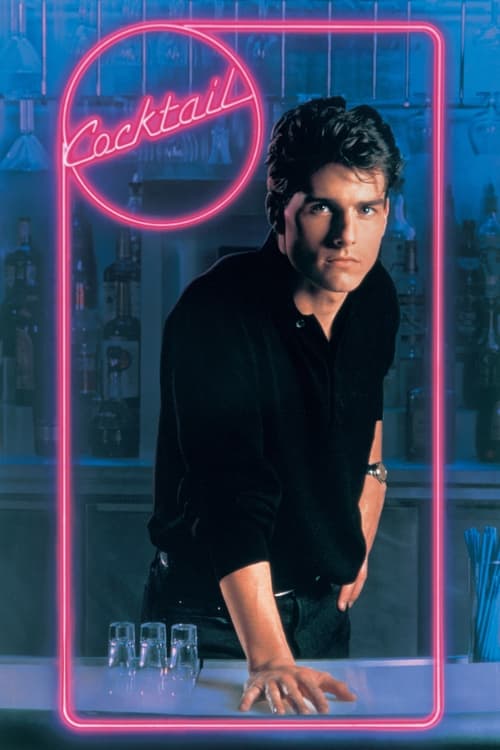
Cocktail (1988)
Directed by Roger Donaldson
No · Ultra Based
How we score movies →Consciousness Markers
The cast is predominantly white and male. Elisabeth Shue is present but relegated to love interest status. No meaningful representation of marginalized groups.
Doug Coughlin delivers cynical philosophical monologues about life and money with considerable self-satisfaction, though the film does not present these as explicitly preachy lectures.
The film includes a Jamaica sequence but treats it as an exotic backdrop rather than engaging with any meaningful racial or postcolonial consciousness.
The film is actively hostile to feminist sensibilities. Female characters exist primarily as romantic interests or objects of male desire, with minimal agency.
The film prioritizes conventionally attractive bodies and uses them as markers of success and desirability without any body diversity.
No LGBTQ+ themes, characters, or representation. The film operates entirely within heteronormative frameworks.
Climate change and environmental concerns are entirely absent from the narrative.
The film explicitly celebrates capitalism and entrepreneurship as the path to happiness and fulfillment.
No engagement with neurodivergent representation or themes.
The film makes no attempt to reexamine historical narratives or challenge established historical perspectives.


Synopsis
After being discharged from the Army, Brian Flanagan moves back to Queens and takes a job in a bar run by Doug Coughlin, who teaches Brian the fine art of bar-tending. Brian quickly becomes a patron favorite with his flashy drink-mixing style, and Brian adopts his mentor's cynical philosophy on life and goes for the money.
Why it received this score
Roger Donaldson's "Cocktail" stands as a monument to pre-woke masculine ideology, a film so thoroughly committed to celebrating the pursuit of wealth and casual exploitation that it reads now like an inadvertent parody of 1980s values. Tom Cruise's Brian Flanagan is presented as an aspirational figure: ambitious, good-looking, and willing to discard any principle in service of financial gain. The film frames this not as cautionary but as admirable. His romantic entanglement with Elisabeth Shue's character exists primarily as a plot device to validate his desirability rather than as a genuine partnership, and Shue spends much of the runtime existing in relation to Cruise's ambitions.
The supporting female characters function almost exclusively as objects of male desire or obstacles to male bonding. Lisa Banes and Kelly Lynch appear largely to demonstrate the protagonist's sexual magnetism. The film's narrative spine centers entirely on the mentorship between Brian and Doug Coughlin, played by Bryan Brown, with their friendship presented as the emotional core of the story. Women enter and exit this narrative as complications or conquests. There is no attempt to grant them interiority or agency independent of the male storyline.
Viewed through contemporary standards, the film's complete absence of intersectional consciousness is almost refreshing in its honesty. It makes no pretense toward diversity, inclusion, or feminist sensibility. It is what it is: a paean to individualistic capitalism, masculine ambition, and the fantasy that one can achieve unlimited financial success through charm and disregard for others. By modern measures, this registers as politically regressive. Yet the film's makers clearly did not believe they were making anything controversial. They were simply telling a story about men succeeding in a man's world. That innocence of the transgression is, in its own way, the most interesting thing about it.
Analysis generated by our Consciousness Algorithm
Critic Reviews
“Tom Cruise does with bartending pretty much what he did with a pool cue in "The Color of Money." In other words, he shows skill at a con game while being less successful with the woman in his life. [29 Jul 1988, p.A]”
“The more you think about what really happens in Cocktail, the more you realize how empty and fabricated it really is.”
“Cruise oozes as much charm as in Top Gun and The Colour of Money, but the mix of bar-acrobatics and Caribbean love isn't anywhere near strong enough to get you drunk.”
“Cocktail, has no reason for being other than to market the Cruise charm like a cheap celebrity perfume. It is a bottle of rotgut in a Dom Perignon box. [8 August 1988, p.68]”