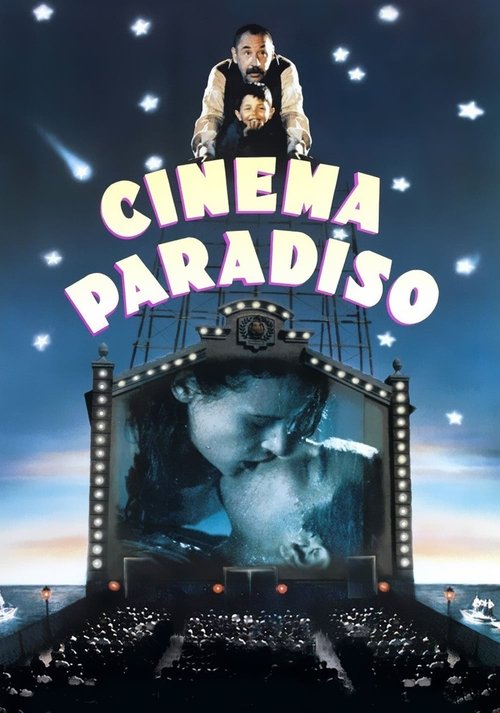
Cinema Paradiso (1988)
Directed by Giuseppe Tornatore
No · Ultra Based
How we score movies →Consciousness Markers
The cast is entirely Italian and reflects the village setting naturally, but women are consistently secondary characters. Female roles are limited to romantic interests, mothers, and background figures with minimal agency or development.
The film occasionally verges on preachy in its celebration of cinema as art form and its mourning of lost innocence, but this is mild and woven into the narrative rather than imposed as external commentary.
The narrative structure requires the protagonist to abandon his passion and friendship for romantic domesticity with a woman, framing adult female relationships as a civilizing force that necessitates loss. No meaningful examination of gender dynamics.
No LGBTQ+ themes, representation, or subtext. The film is entirely heteronormative in its romantic and social frameworks.
The film takes place in a homogeneous Sicilian village and contains no engagement with racial or ethnic diversity beyond the Italian context. No racial consciousness is present or relevant to the narrative.
Climate change and environmental concerns are entirely absent from the film. The natural world serves only as backdrop to nostalgic memory.
No critique of capitalism or class structures. The village economy is treated as quaint and timeless rather than as a system worthy of interrogation or change.
Body positivity as a concept does not apply. The film contains conventional beauty standards and no engagement with body image, disability representation, or related concerns.
No representation of neurodivergence or disability. Characters are not coded as neurodivergent and the film contains no engagement with these themes.
The film does not engage with historical revisionism. It is set in postwar Sicily but treats history as backdrop rather than subject, avoiding any reexamination of historical narratives.


Synopsis
A filmmaker recalls his childhood, when he fell in love with the movies at his village's theater and formed a deep friendship with the theater's projectionist.
Why it received this score
Cinema Paradiso is a work of profound nostalgia, a film that loves cinema itself with the uncomplicated devotion of a child discovering magic for the first time. It is also, by any serious measure, almost entirely untouched by the social consciousness that would come to dominate cultural discourse decades after its release. The film centers on two men, their bond, and the movies they share, with women relegated to peripheral roles as romantic interests, mothers, and village fixtures. When a female character does appear, she exists primarily to demonstrate that the protagonist must eventually abandon his youthful passions and accept adult responsibilities, which in this narrative means renouncing both his friend and his cinema obsession for the prospect of romantic domesticity.
The village itself exists in a kind of timeless Italian pastoral fantasy, stripped of any genuine social or political content. There is no meaningful engagement with class structures, economic hardship, or the complexities of postwar Italian society. The church and its censorship represent a gentle, almost affectionate obstacle rather than a genuine subject of critique. The film's relationship to authority is fundamentally one of wistful acceptance: the priest who cuts scenes from films is portrayed with warmth and understanding, not as a symbol of repression worth interrogating. The entire enterprise is suffused with a masculine melancholy, a meditation on lost youth and the corrupting forces of time and adulthood, but there is no attempt to examine whose losses these are or why the cost of maturity should be paid exclusively through masculine renunciation.
This is not a failure of the film as an artistic work. It is instead a film from 1988 that reflects the preoccupations and blind spots of its moment, made with genuine skill and feeling. To score it for progressive consciousness would be to misunderstand what the film is attempting, which is an act of pure cinematic nostalgia untethered to any particular social vision beyond the preservation of memory itself. It succeeds at this entirely, and remains beautiful for precisely that reason.
Analysis generated by our Consciousness Algorithm
Critic Reviews
“Remain open to fantasies but not be consumed by them. These are good lessons for a would-be director. They are good lessons for everybody. And no recent movie has taught them with more patient sweetness. [Feb. 5, 1990]”
“Cinema Paradiso converts you to the credo that art can indeed be holy.”
“You leave Cinema Paradiso with that feeling that's kind of like getting kicked in the stomach, but nice. It's one of those breathless, swept-away-by-a-movie experiences that you might have once a year, if you're lucky. [16 February 1990, Daily Notebook, p.E-1]”
“A few moments of sly inspiration are not enough to carry an entire feature; along with the tears, it leaves behind an aftertaste of phoniness. [16 March 1990, Friday, p.H]”