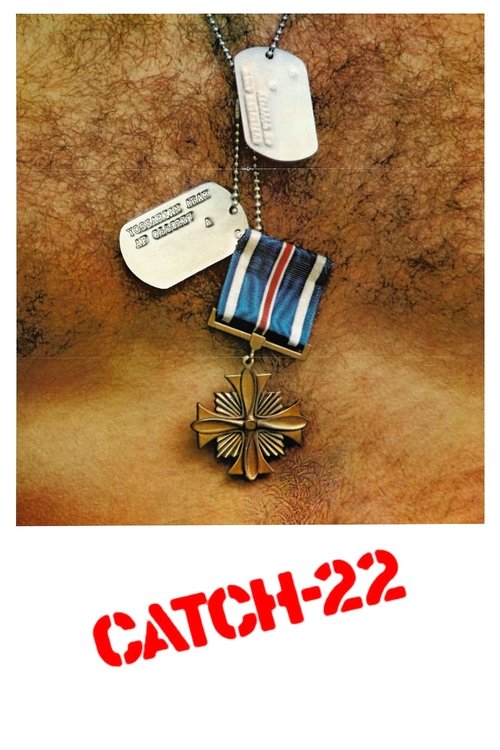
Catch-22 (1970)
Directed by Mike Nichols
No · Ultra Based
How we score movies →Consciousness Markers
The film critiques military-industrial logic and bureaucratic absurdity as mechanisms of institutional dehumanization. This emerges as a humanist objection rather than explicit 2020s-style anti-capitalism.
The film's satirical approach occasionally borders on preachy, using absurdism to make explicit points about war's illogic and institutional dehumanization. The tone can feel preachy despite its comedic vehicle.
The cast is predominantly white and male. Paula Prentiss is the sole female character of note, presented as a romantic interest rather than a fully realized character. No meaningful effort toward diverse casting.
Catch-22 uses mental illness as a comedic premise and satirical device rather than authentic representation. The protagonist's feigned insanity is a plot mechanism, not a genuine exploration of neurodivergence.
Female characters are minimal and peripheral. Nurse Duckett exists primarily in relation to male desire and agency. No examination of gender dynamics or female autonomy.
No LGBTQ+ themes, characters, or representation present. The film makes no acknowledgment of sexual orientation or gender identity.
The film contains no apparent racial consciousness or examination of racial dynamics. The military setting is presented without racial dimension or commentary.
Climate change or environmental concerns are not present in the film. The environmental impact of war is not addressed.
No engagement with body positivity, disability representation, or body-related social consciousness. Physical bodies are treated as instrumental to military function.
The film does not revise historical narratives or challenge conventional historical interpretation. It is a satirical commentary on war set within a historical framework.


Synopsis
A WWII military pilot makes a valiant effort to be certified insane in order to be excused from flying missions. But there's a catch.
Why it received this score
Catch-22 arrives at the tail end of the classical Hollywood era with an anti-war sensibility that feels almost quaint in its earnestness. Mike Nichols' adaptation of Heller's novel is primarily concerned with the absurdist machinery of military bureaucracy and the moral bankruptcy of war itself, which are substantive themes but not markers of contemporary social consciousness. The film exists in a pre-woke cultural moment when one could satirize institutional violence without considering the demographic composition of the institutions being satirized. Its anti-capitalist undertones emerge mainly through its critique of military-industrial logic and the commodification of human life, though this reads more as a timeless humanist objection than as 2020s-style social critique.
The cast is overwhelmingly male and white, which was unremarkable for 1970 but would be flagged by modern standards. Paula Prentiss appears as Nurse Duckett, a female character whose agency exists primarily in relation to the male pilots she encounters. The film makes no apparent effort to examine gender dynamics or power imbalances in its military setting, nor does it address racial representation. Art Garfunkel's appearance is notable chiefly for its oddness rather than for any progressive statement. The film's humor derives from the collision between individual sanity and institutional madness, not from any exploration of identity or systemic injustice through a contemporary lens.
What distinguishes Catch-22 from a higher score is its complete lack of engagement with any of the specific markers of 2020s cultural consciousness. It is a film about the horrors of war made during an unpopular war, but it achieves this through allegory, absurdism, and institutional critique rather than through demographic representation or explicit social positioning. This is not a failing on the film's part. It is simply a film from another era, operating according to different artistic principles. We observe it now as a historical artifact of progressive sensibility circa 1970, which is a different creature entirely from what contemporary progressive sensibility has become.
Analysis generated by our Consciousness Algorithm
Critic Reviews
“The most moving, the most intelligent, the most humane--oh, to hell with it!--it's the best American film I've seen this year.”
“The director of Who’s Afraid of Virginia Woolf? and The Graduate is more at home with minute personal tensions than with the epic hysteria this project required, so file the film under botched masterpieces.”
“Catch 22 will be remembered as a screamingly terrifying and funny interpretation of Joesph Heller's classic work. [27 July 1970, p.42]”
“This film wants to be bleak, nihilistic, and darkly hilarious but Catch-22 emerges as an exercise in frustration for those unprepared for Nichols's episodic, detached, and surreal treatment of the novel. Like a nightmare, the film shifts from one bizarre episode to another, with Alan Arkin's dazed Yossarian reacting to the madness that surrounds him, but second only to the viewer.”